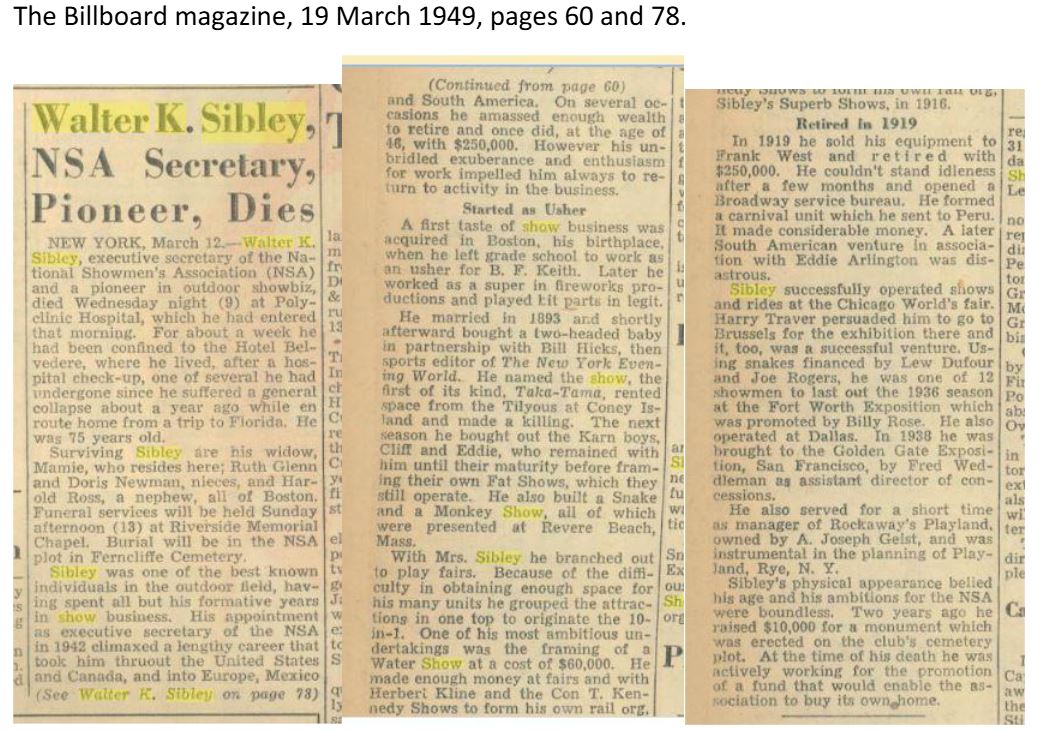
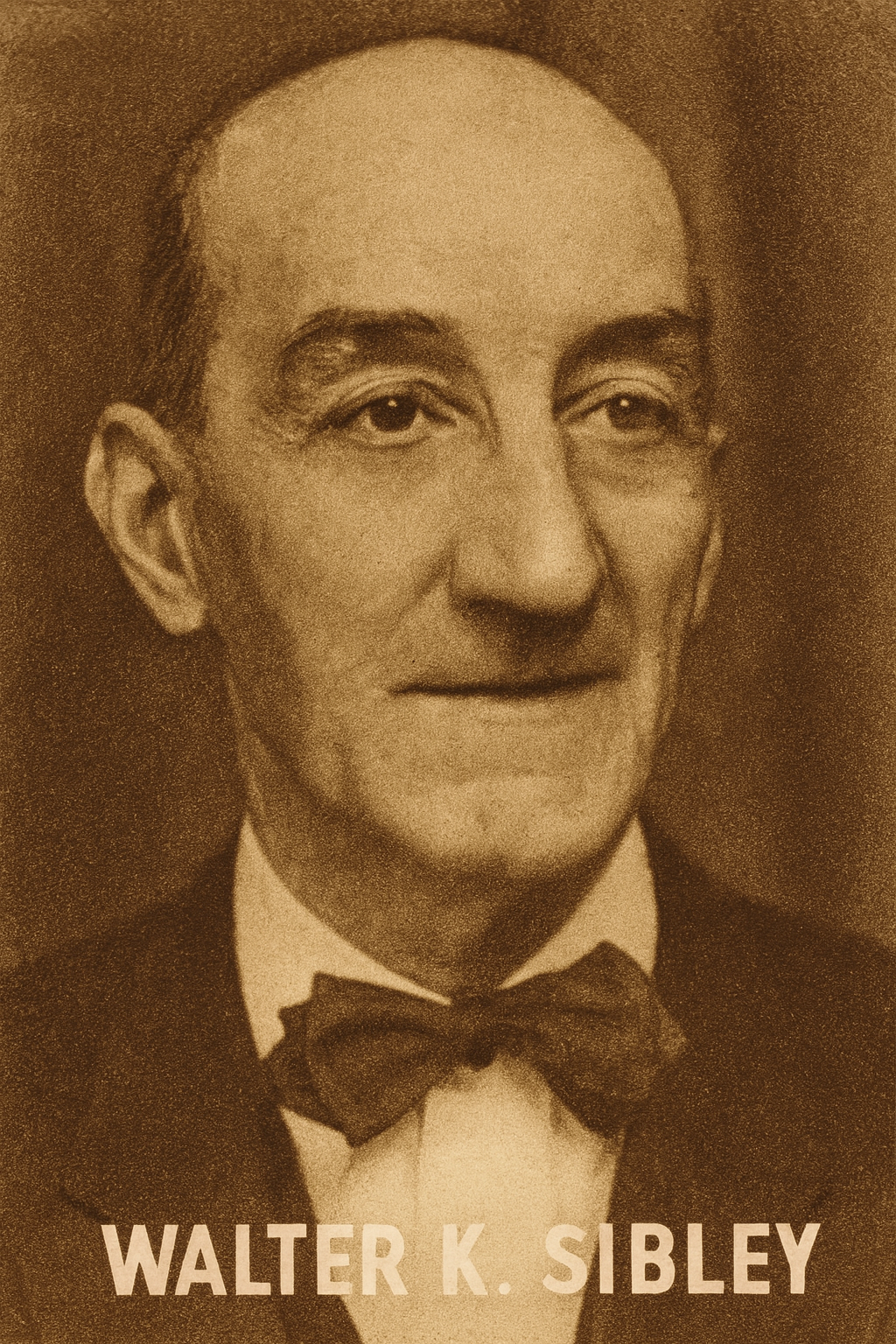
Walter K. Sibley (born Walter Kcurron Zebley, 1873–1949) was one of the most inventive and influential figures in early American outdoor entertainment. Born in Philadelphia to a family with Russian roots, he grew up in Boston and left school early to work as an usher for B.F. Keith, long before Keith built his vaudeville empire. From there, Sibley absorbed every corner of show business: he worked as a super(extra) in Boston theatre spectacles, appeared in massive fireworks productions, and even tried prizefighting and professional bicycle racing before turning fully to the midway.
He married Mary Irene Nulligan in 1893 under his birth name, Zebley, but soon reinvented himself as Walter K. Sibley, the identity he carried for the rest of his life. His first major success came with Taka‑Tama, a two‑headed baby exhibit he booked at Coney Island. He followed with a string of profitable pit shows, including the Karn Brothers (“Jack & Jill”), a giant snake show, and a baboon billed as “Zeno the Ape Man.” These attractions earned strong grosses at Revere Beach and later at the Canadian National Exhibition in Toronto.
It was in Toronto in 1904 that Sibley made his most enduring contribution to carnival history. Faced with limited midway space, he combined several small pit shows under one tent for a single admission price. The experiment evolved into the ten‑in‑one, a format that became the backbone of the American sideshow. Competitors protested, then rushed to copy him. Sibley’s innovation changed the economics of the midway forever.
By the 1910s, Sibley was operating on a larger scale. He built an elaborate water show for the Herbert K. Kline Shows and remained with the organization until it collapsed in 1914. With four cars of equipment, he launched his own railroad carnival, Sibley’s Superb Shows, which toured successfully beginning in 1916. In 1919, having reached the quarter‑million‑dollar goal he once promised his wife, he sold his carnival to Frank West, helping launch West’s Bright Lights Show and eventually West’s World’s Wonder Shows.
Sibley continued to work internationally, sending units to South America, exhibiting a whale at the Chicago World’s Fair, and operating attractions at major expositions from Brussels to San Francisco. His shows ranged from snake acts to nudist camp exhibits to the ever‑popular Headless Girl.
In 1942, he became Executive Secretary of the National Showmen’s Association, where he remained a driving force until his death in 1949. He is buried in the NSA plot at Ferncliff Cemetery.