Show Owner Joseph G. Ferari (1868 – 1953)
Animal Trainer | Carnival Builder | Keeper of Old-Time Show Lore
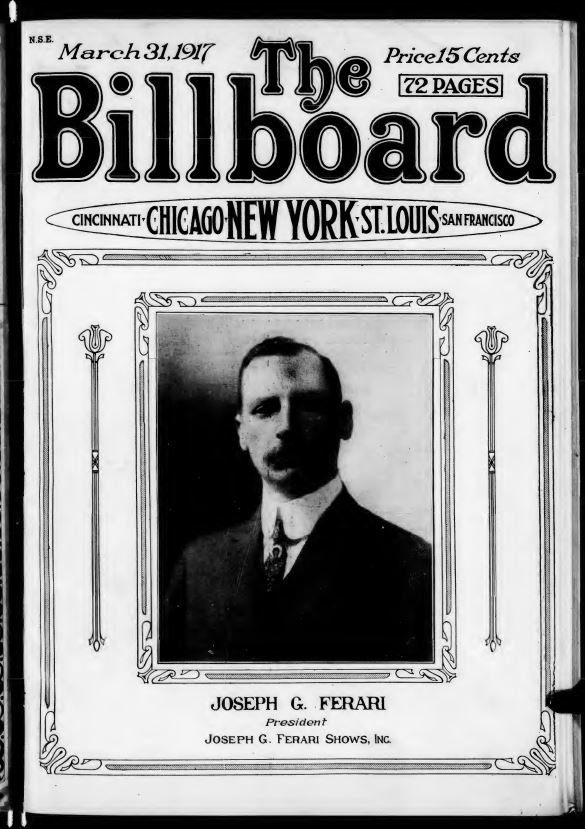
Joseph G. Ferari was never the loudest voice on the midway — but he was one of its most enduring.
Born January 14, 1868, in Leeds, Yorkshire, England, Joseph Ferari was a third-generation traveling showman, the son of an Italian animal exhibitor who toured England for years. Though Italian by heritage, Joseph proudly carried his Cockney English identity throughout his life, a trait remembered fondly by showmen who later gathered around him in New York’s downtown “hangouts,” listening to his stories of the old road.
Unlike his older brother Francis A. Ferari, Joseph did not seek the spotlight early. He remained with his father’s wild animal show in England while Francis struck out on his own. Joseph’s path changed suddenly when a relative died unexpectedly, leaving a trained animal act without a handler. With no formal preparation, Joseph donned the trainer’s costume, entered the arena, and calmly worked the lions. From that moment on, his future as a wild animal trainer was sealed.
Joseph arrived in the United States in the 1890s with Francis and Frank Bostock, participating in the formative years of the American carnival midway. During the era of the Bostock–Ferari Midway Carnival Company (1899–1902), Joseph became known not for self-promotion, but for reliability — managing animal acts, supervising staff, and maintaining standards that made Ferari attractions highly bookable.
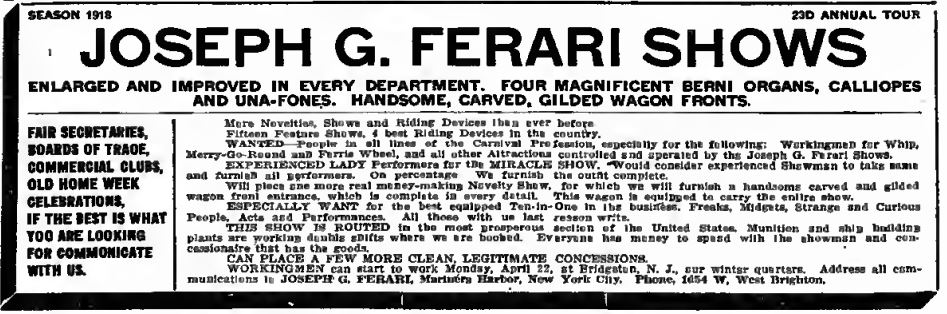
After the Ferari Brothers dissolved their partnership in 1905, Joseph quietly built his own legacy. Beginning in 1906, he operated Joseph G. Ferari Shows, touring consistently through the 1918 season. His operation featured handsomely carved and gilded wagon fronts, animal exhibitions, concessions, and rides — a balance of spectacle and order that appealed strongly to fairs, Elks lodges, and civic celebrations.
By 1912, Joseph had risen to equal public stature with his brother, advertising himself as “Colonel” Joseph G. Ferari and appearing multiple times on the cover of Billboard, including as president of Joseph G. Ferari Shows. Yet even with this recognition, he remained known among showmen as approachable, thoughtful, and deeply knowledgeable.
After selling his show equipment in 1919, Joseph operated a carousel factory on Staten Island before retiring as his health declined. In his later years, he became a living archive — sharing firsthand accounts of early carnival life in a broad Cockney dialect that delighted younger operators eager to understand where the business had come from.
Joseph G. Ferari died on May 9, 1953, at the age of 85. He was buried in Moravian Cemetery, Staten Island.
Legacy:
Joseph G. Ferari did not chase legend — he carried it.
Through skill, steadiness, and memory, he preserved the soul of the early midway long after the banners came down.