Diving Horse Act On The Carnival Midway
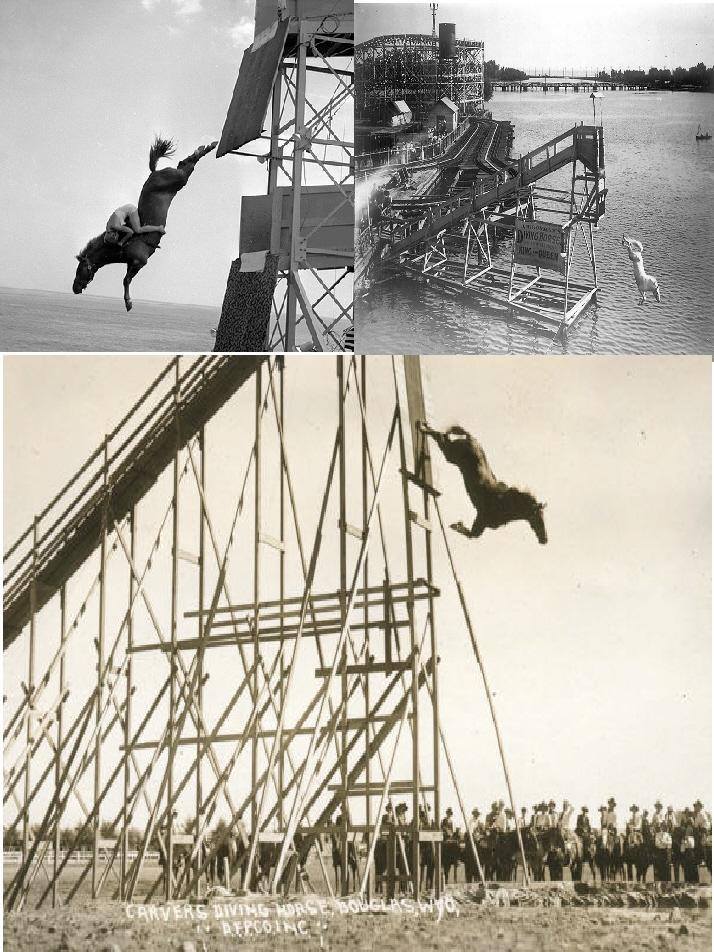
Many ideas for ‘free acts’, such as crowd drawing attractions at fairs, became popular in the early days of carnivals. People tried all sorts of death defying stunts to compete with one another for top billing at the biggest fairs. Among these was the Diving Horse.
William “Doc” Carver, a Buffalo Bill “sidekick, supposedly “invented” the idea of horse diving exhibitions, although history is a little fuzzy about these facts. Allegedly, in 1881, Carver was crossing a bridge over the Platte River in Nebraska when it partially collapsed. His horse fell or dived into the water below, inspiring Carver to develop the diving horse act. What is factually known is that the act became part of his ‘Great Carver Shows’. They had many riders, mostly young women. His partner, Al Floyd Carver, built the ramp and tower, and his rider, Lorena Carver, was the first. Sonora Webster joined the show in 1924 and later married Al Floyd Carver. The show later became a permanent fixture at Atlantic City, New Jersey’s very popular venue, the Steel Pier. There, Sonora, Al, and Lorena continued the show following Doc’s death.
The job was dangerous. Once the horse had dived off into the tank, it would reach for the bottom with its front feet and when it touched, would shove off very hard for the surface. If the rider didn’t clamp their head to the side of the horse’s neck, their nose or cheekbone could be broken when the horse’s neck popped up. Although some claim that not “a horse or rider was ever seriously injured,” other sources disagree.
At one show in 1931, Sonora’s horse, Red Lips, lost its balance on the platform and performed a nosedive straight into the water. Sonora threw her weight back to keep the horse from flipping onto its back. They landed safely, but Sonora hit the water with her eyes open. She experienced mildly foggy vision, but assumed that it was nothing serious. However, her eyesight continued to get worse until she was totally blind. The impact of hitting the water had broken blood vessels in her eyes, which led to blood clots that caused detached retinas. She continued diving for 11 years after her blindness. She was so successful that for around 5 yrs. No one realized she was blind. In 1991, the film “Wild Hearts Can’t Be Broken,” based on Webster’s life and her memoir “A Girl and Five Brave Horses,” was released.
The shows eventually received very strong criticisms of animal welfare abuses, which contributed to the decline of their popularity after World War II. There were allegations of using prods, electrical jolts, and trap doors to get unwilling horses to dive. The famous Atlantic City Steel Pier diving horses, after unbelievably difficult training, had to spend their lives diving 60 feet into 10 feet of water four times a day, seven days a week. Then they were sent to an auction when they couldn’t perform anymore, and sold to anyone who could get something more out of them before eventual slaughter. The act finally ended when the pier was sold to Resorts International. A recent attempt to revive the shows at Steel Pier was halted after animal welfare advocates petitioned the owners not to hold them. The president of the Humane Society stated, “This is a merciful end to a colossally stupid idea.”