Adolph Seeman Biography
The Magician Who Built America’s First Crystal Maze
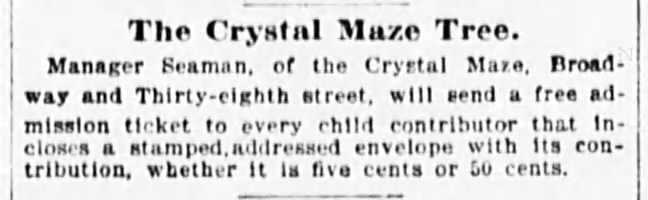
Adolph Seeman stands at the crossroads of illusion, architecture, and early American amusement. A German-born magician with a gift for mechanical design, he created the first Crystal Maze in the United States at Broadway and 38th Street — a mirrored labyrinth lit by electric bulbs, Moorish arches, and theatrical atmosphere. His work became a blueprint for the funhouses and glass houses that would later define the midway.
Early Life and Craft
Seeman’s early years from A Pictoral History of The American Carnival by Joe McKennon – Page 70
“Adolph Seeman was born in Stockholm, Sweden, on July 28, 1852. A son and a grandson of noted magicians. He went to school in Sweden, Berlin, and Saxony.
He acquired a degree in Civil Engineering. He then served his allotted time in the Swedish Navy and was discharged in 1874. Baron Seeman, his father, asked him to join the magic show as an assistant. In 1876, he helped transport a circus overland into Siberia and back with good financial returns.
In 1881, Baron Seeman’s Magic show was brought to Coney Island for the summer season. After the Coney Island season closed, they toured the larger cities of the United States with Adolf as manager of the troupe. Baron Seeman died in Texas in 1886, and Adolf took over the duties of magician. He billed himself as Adolf The Magician until 1893. He built the first crystal Maze ever built in America at 38th and Broadway in New York. It was a huge success. He and Victor Leavitt built a portable maze to tour fairs in the late nineties. In the spring of 1898, he was approached by the Elks Club of Zanesville, Ohio, asking for information about street fairs. He produced a street fair for them, which was copied by other Elks in Ohio. Frank Gaskill was a visitor and took notes. Seeman always claimed that this was the first Elk’s Lodge Street Fair anywhere. Known as Prof. Adolph Seeman the World’s Greatest Illusionist, known for “Electra” and the Great “Cremation”.
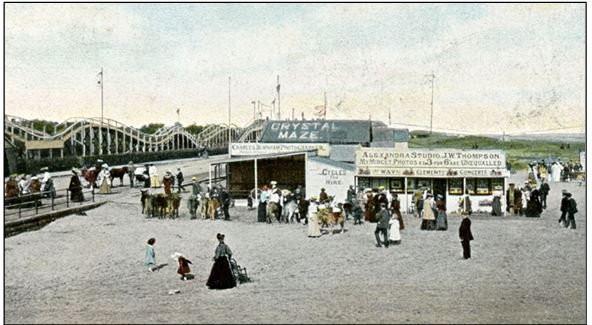
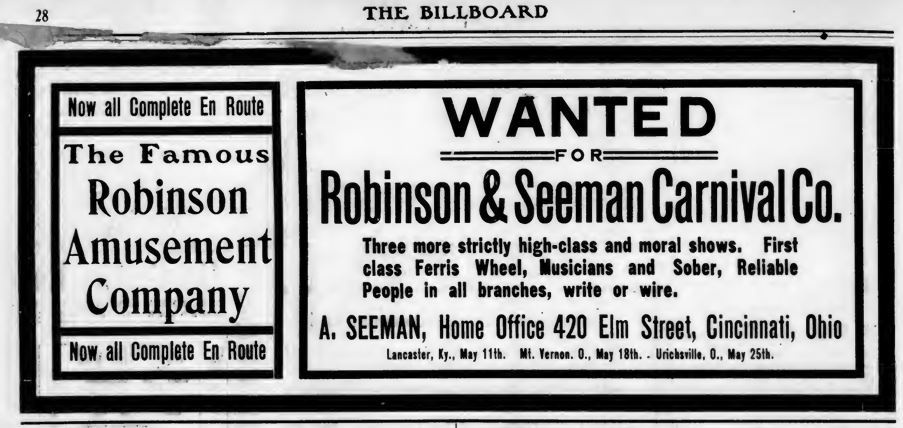
He then went into the carnival business exclusively. He was partnered with many showmen, including Bostock, Jarvis, Millican, and Leavitt, in midway operations. He was manager of the Dan Robinson Show and always managed the shows in which he was a partner. He joined the new Rubin & Cherry Shows as a builder and designer. His designing and building of show fronts, shows, and wagons have been given credit for the success of that show. He was a genius as a designer and builder.
He was with the T. A. Wolfe Shows in 1923, but his recurring throat trouble took him back to Chicago for medical treatment. He died of throat cancer in Chicago’s American Hospital on August 21, 1924.
Showman’s League of America took charge of the services, which were held in a local funeral home on August 21st. He was interned at the Showmen’s Rest by his brother showmen, but his talent for illusion and mechanical staging brought him into the orbit of major showmen. His performances blended sleight of hand with emerging technologies, making him a pioneer of immersive entertainment.” (Sometimes his name is as Adolph Seaman)
The Crystal Maze at Broadway & 38th Street
- First American mirrored maze
- Moorish pillars and arches
- Electric lighting used as a theatrical device
- A sensory experience that influenced later amusement architecture
This maze became a sensation, drawing crowds who had never before encountered such an environment. Its design language would echo across the next generation of attractions.
Touring With Bostock and Leavitt
Seeman toured with Frank Bostock and Frank C. Bostock’s partner, Samuel Leavitt. Their shows combined exotic animals, theatrical staging, and architectural spectacle. Seeman’s Crystal Maze became part of this touring empire, exposing thousands to the new art of immersive illusion.
Influence on the Salt Palace
The Salt Palace in Salt Lake City (1899) carried unmistakable echoes of Seeman’s aesthetic:
- Mirrored corridors
- Moorish ornamentation
- Electric light as spectacle
- Architectural illusion as entertainment
Though Seeman did not build the Salt Palace, his design DNA is visible throughout its structure. His work helped shape the visual and emotional vocabulary of the venue. It’s no wonder he was drawn to the Salt Palace.
Legacy Through the DeKreko Brothers
The DeKreko Brothers — masters of mechanical funhouses and glass houses — inherited Seeman’s lineage. Their later work carried forward his principles:
- Reflection and distortion
- Mechanical surprise
- Architectural illusion
- Theatrical lighting
Seeman’s influence became part of the traveling carnival tradition.
Lineage and Connections
- Adolph Seeman → Crystal Maze
- Crystal Maze → Bostock & Leavitt Tours
- Bostock → Salt Palace
- Salt Palace → DeKreko Brothers
This lineage forms a continuous thread through the history of American amusement.
Closing Reflection
Adolph Seeman’s legacy is not just a biography — it is a design language, a way of shaping space, light, and emotion. His mirrored corridors still echo in every funhouse, every glass maze, every midway attraction that invites visitors to lose themselves in wonder.
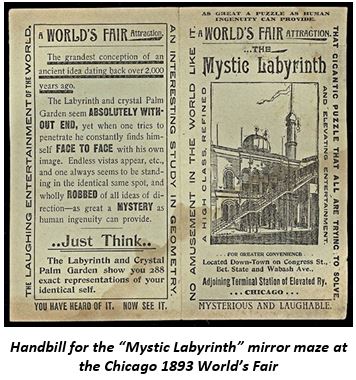
The “Mystic Labyrinth” at the 1893 Chicago World’s Fair (World’s Columbian Exposition) was a popular mirror maze attraction located in the Midway Plaisance, offering confusing pathways and illusions for visitors, a precursor to modern funhouses and glass houses, and was part of the fair’s entertainment section alongside the original Ferris Wheel and other exotic displays. Handbills advertised this “Mystic Labyrinth” mirror maze, which was later shipped out from Chicago after the fair closed, highlighting its success as an immersive, perplexing attraction.