Traveling Carnival History, American Circus History, Sideshow History, and more . . .

Old Carnival Photos, Carnival History, Circus History, Traveling Shows

  • HOME
    • The Heart of The American Midway
  • THE AMERICAN MIDWAY SHOWMEN
    • Biographies of the American Midway
      • Biographies
        • Early Pioneers (1893 – 1905)
        • Expansion Era (1905 – 1915)
        • Growth of The Railroad Shows (1915 – 1929)
        • The Golden Age of The American Midway (1930s – 1950s)
        • Television, Highways, and Change of American Midways (1950s -1970s)
  • CARNIVAL COMPANIES
    • Carnival Company Library
  • COLLECTIONS
    • Old Carnival Midway Photos
    • History Of The American Carnival
      • Traveling Carnivals In America Brought Earliest Form of Entertainment
        • Patent Medicine Shows
      • Traveling Show History
        • How The Traveling American Carnival Grew
      • Railroad History Of Carnival and Circusl Trains
  • AMERICAN MIDWAY RESEARCH LIBRARY
    • How To Use The Research Library
  • ABOUT
    • A Brief Bio
      • Doc’s Midway Art
    • CONTACT
You are here: Home / Carnival Free Acts / HORSE AND RIDER DIVING MIDWAY FREE ACT

HORSE AND RIDER DIVING MIDWAY FREE ACT

February 7, 2026 By Editor

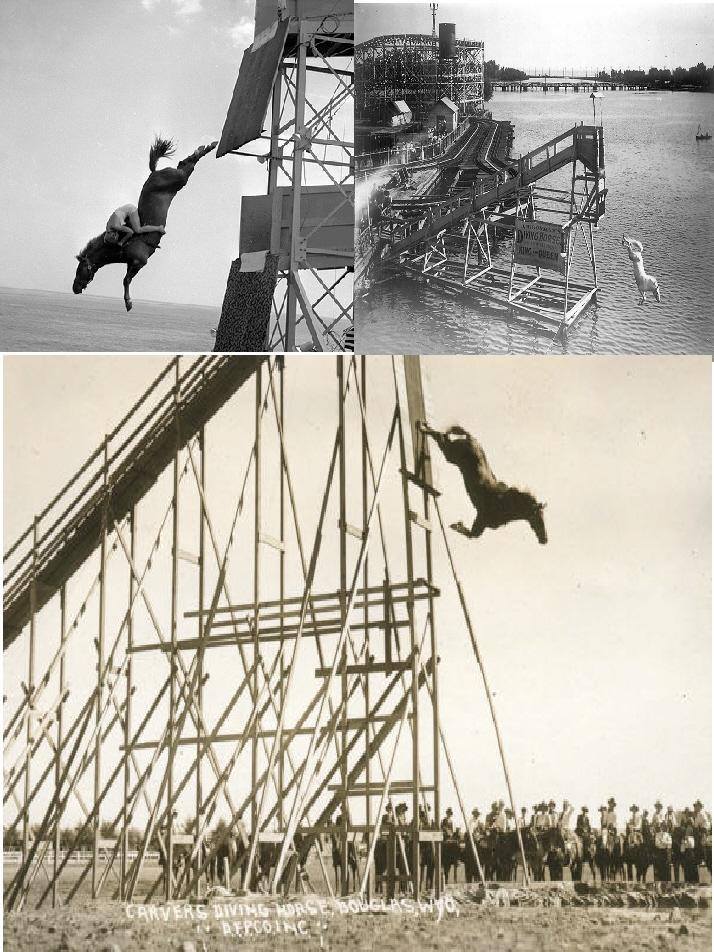
Diving Horse Act On The Carnival Midway
alt=Diving Horse Act On Carnival Midway

Many ideas for ‘free acts’, such as crowd drawing attractions at fairs, became popular in the early days of carnivals. People tried all sorts of death defying stunts to compete with one another for top billing at the biggest fairs. Among these was the Diving Horse.
William “Doc” Carver, a Buffalo Bill “sidekick, supposedly “invented” the idea of horse diving exhibitions, although history is a little fuzzy about these facts. Allegedly, in 1881, Carver was crossing a bridge over the Platte River in Nebraska when it partially collapsed. His horse fell or dived into the water below, inspiring Carver to develop the diving horse act. What is factually known is that the act became part of his ‘Great Carver Shows’. They had many riders, mostly young women. His partner, Al Floyd Carver, built the ramp and tower, and his rider, Lorena Carver, was the first. Sonora Webster joined the show in 1924 and later married Al Floyd Carver. The show later became a permanent fixture at Atlantic City, New Jersey’s very popular venue, the Steel Pier. There, Sonora, Al, and Lorena continued the show following Doc’s death.
The job was dangerous. Once the horse had dived off into the tank, it would reach for the bottom with its front feet and when it touched, would shove off very hard for the surface. If the rider didn’t clamp their head to the side of the horse’s neck, their nose or cheekbone could be broken when the horse’s neck popped up. Although some claim that not “a horse or rider was ever seriously injured,” other sources disagree.
At one show in 1931, Sonora’s horse, Red Lips, lost its balance on the platform and performed a nosedive straight into the water. Sonora threw her weight back to keep the horse from flipping onto its back. They landed safely, but Sonora hit the water with her eyes open. She experienced mildly foggy vision, but assumed that it was nothing serious. However, her eyesight continued to get worse until she was totally blind. The impact of hitting the water had broken blood vessels in her eyes, which led to blood clots that caused detached retinas. She continued diving for 11 years after her blindness. She was so successful that for around 5 yrs. No one realized she was blind. In 1991, the film “Wild Hearts Can’t Be Broken,” based on Webster’s life and her memoir “A Girl and Five Brave Horses,” was released.
The shows eventually received very strong criticisms of animal welfare abuses, which contributed to the decline of their popularity after World War II. There were allegations of using prods, electrical jolts, and trap doors to get unwilling horses to dive. The famous Atlantic City Steel Pier diving horses, after unbelievably difficult training, had to spend their lives diving 60 feet into 10 feet of water four times a day, seven days a week. Then they were sent to an auction when they couldn’t perform anymore, and sold to anyone who could get something more out of them before eventual slaughter. The act finally ended when the pier was sold to Resorts International. A recent attempt to revive the shows at Steel Pier was halted after animal welfare advocates petitioned the owners not to hold them. The president of the Humane Society stated, “This is a merciful end to a colossally stupid idea.” 
Filed Under: Carnival Free Acts

Midway Slideshow

Books About Gibtown

  • Gibtown, Through The Camera Lens of Diana Phillips Book – Gibtown, Through The Lens of Diana Phillips

Carnival

  • John Dillinger's Car An short story in the site Sideshow World

Carnival and Circus Links

  • Buckles Blog Spot An interesting site full of carnival and circus information and photos from the past to present day.
  • Carousel World worlds leading collectors, and foremost authorities on antique carousels and carousel art.
  • Circus Blog A cool site loaded with historical information about the circus and carnival.
  • Circus Historical Society Circus Historical Society
  • Greater Show World….The Voice Of Show Business 1936 An amazing old magazine full of articles describing the Show Business Midways of 1936.
  • http://dick-dykes.blogspot.com/ A nifty site filled to the brim with cool videos, great stories and pictures.
  • National Carousel Association Index of North American Carousels
  • Sawdust and Spangles This is a great site for circus historians and circus model builders.

Carnival and Circus Museums

  • C. W. Parker Carousel Museum 1901 C.W. Parker Carousel Museum
  • Carnival World Museum American Carnival History Cultural Museum
  • Circus Historical Society Circus Historical Society
  • Circus World Museum Baraboo Wisconsin Circus History Museum
  • Herschell Carrousel Factory Museum Carousel History Museum
  • The Carousel Museum Carousel History Museum
  • The Ringling Circus Museum Ringling Cuircus Museum

Carnival and Circus Research Sources

  • Billboards Online at World Radio History Billboards from 1894 – 1921
  • New York Clipper New York Clipper Trade Paper – Carnival, Circus, Theater, Music
  • Old "Billboard Magazines" From A Bygone Era Old Billboard Magazines Starting From 1942 Featuring Ads And Stories From The Sawdust Trails Of The Times

Carnival Organizationa and Associations

  • Gibtown Bike Week I I S A and Showman’s Shrine Club sponsors Gibtown Bike Week Annually
  • International Independent Showmen's Association International Independent Showmens Associationor IISA, Gibsonton

Carnival, Circus, and Gibsonton Images

  • USF Showmen's Museum Photograph Collection USF Digital Collection of images portraying the life and times of American Carnival and Circus including Gibsonton

Side Show History

  • Carny World A link to some sideshow history and “freaks”
  • Shocked And Amazed Sideshow Seen Through A Modern Lens
  • Side Show World A site for great stories, photos and links to the backend of the midways of America
  • The Human Marvels A collection of historical “freaks” and brief discriptions of their histories

USF Showmen's History

  • Showmen's Oral History Project Andy Huse, assistant librarian in USF Tampa Library Special Collections, interviews association members involved in circuses, rodeos, and carnivals. Home-based in Gibsonton, Florida, the Showmen’s Association interviews document the careers of various sho
  • USF Showmen's Museum Photograph Collection USF Digital Collection of images portraying the life and times of American Carnival and Circus including Gibsonton

Magic Acts

Magicians Hilliar and Houdini

Midway Magic Acts – Houdini and Hilliar Were Great Friends  William J. Hilliar was a magician and author who edited Billboard‘s “Magic and Magicians” page for many years. He was also close friends with Houdini. “That friendship will always stand out as one of the dominating factors in my life,” said Hilliar. In 1933, Hilliar […]

Carnivals

HAROLD A. BUSHEA

Early Carnival Contracting Agent, Manager, and General Director Harold A. Bushea belongs among the important figures of the formative American traveling midway not because his name appeared above the title of a famous carnival, but because he helped make the organization behind one of those early carnivals work. Before entering the carnival business, Bushea was […]

Carnival Movies

Showbiz And The Big Screen

Hollywood And The Midway Movies Come To The Tented World If you’re like me, you love old films that have anything to do with ‘The Biz’. Victor Mature is great in the 1959 classic: The Big Circus which is an example of a little known Hollywood gem. Elvis Presley in Roustabout features colorful scenes from the […]

Copyright © 2026 · Docs Midway Cookhouse · All rights reserved.