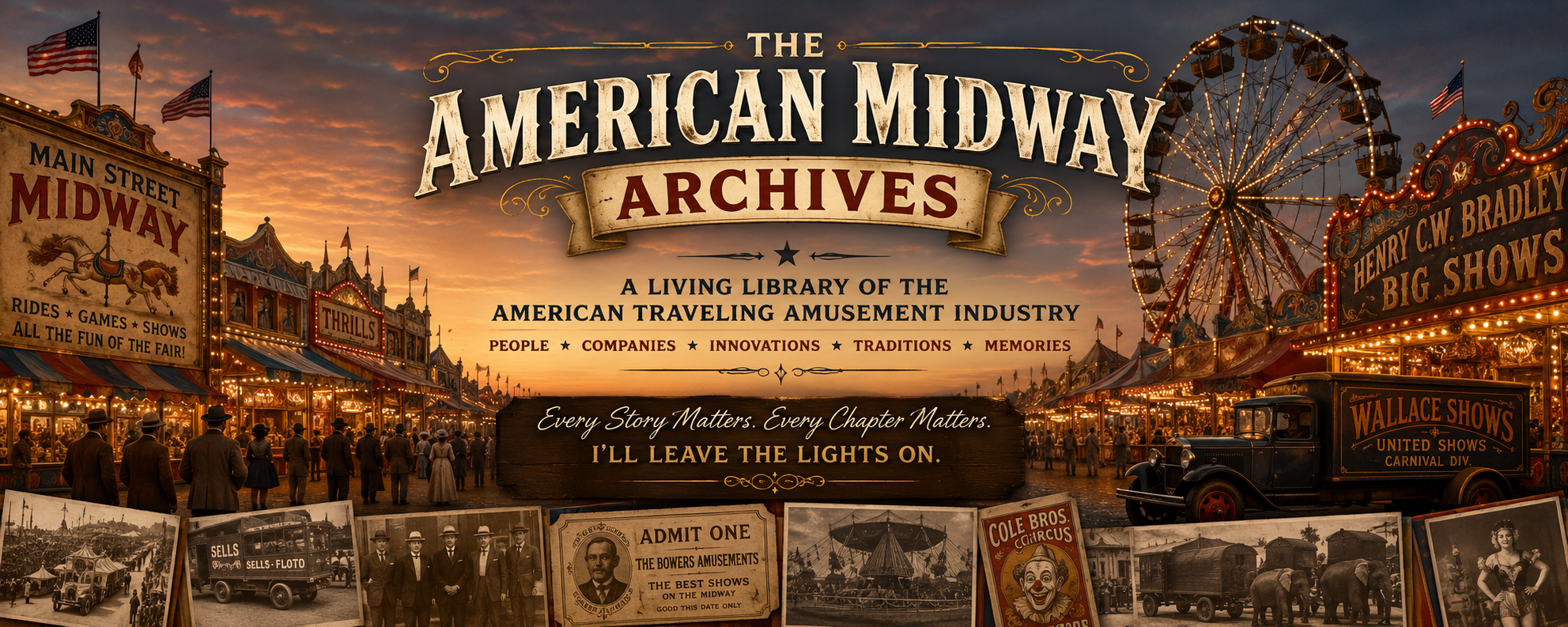
Preserving the People, the Shows, The Memories, and the Story of the American Midway
Our Mission
Where the Magic Meets the People Who Made It Possible
Remember the excitement when the carnival came to town?
The Ferris wheel rising above the fairgrounds. The music drifting through the evening air. The colorful show fronts, the lights, the laughter, the smell of popcorn, and the anticipation of something wonderful waiting just beyond the entrance.
For generations, the American midway was a magical world where families created memories that lasted a lifetime.
Children remembered their first Ferris wheel ride. Parents remembered holding little hands as they walked beneath the lights. Grandparents remembered the fairs of their own childhoods.
And years later, those children brought their own children.
But there was another family story unfolding on the other side of those lights.
The showmen and showwomen who created that magic were raising families of their own.
They traveled from town to town, built businesses, operated attractions, repaired equipment, raised children on the road, and worked long hours to provide for the people they loved.
They faced uncertain earnings, difficult weather, breakdowns, exhausting travel, financial risks, and the everyday responsibilities familiar to families everywhere.
Yet through their ingenuity, determination, and hard work, they created a world of wonder for other families.
One family’s livelihood became another family’s treasured memory.
The American Midway Archives brings these two worlds together.
We invite visitors to step through the first doorway and rediscover the magic they remember.
Then we open another doorway, introducing them to the people who made those memories possible.
And as their stories unfold, we hope readers recognize something of themselves in the hopes, struggles, sacrifices, ambitions, and love of the families who lived and worked on the midway.
Because the magic becomes even more meaningful when we know the people who created it.
Every Story Matters
The mission of The American Midway Archives is to research, document, preserve, and make accessible the history of the American traveling amusement industry—from its roots surrounding the 1893 World’s Columbian Exposition and the Midway Plaisance through the industry that continues today.
At the heart of that mission is a simple belief:
Every story matters.
The American midway was not created by one person, one company, or one moment in history.
It developed through thousands of people who learned, adapted, experimented, failed, rebuilt, traveled, entertained, invented, and found ways to keep the show moving.
Some became famous.
Many did not.
The American Midway Archives exists to find them, document what they contributed, and give their stories a permanent home.
Who Were You?
Every name we encounter begins with a question:
Who were you?
A name in an advertisement may lead to a census record.
A photograph may identify a forgotten carnival company.
An obituary may reveal a partnership.
A route notice may establish where a show traveled.
A family photograph may preserve the only known image of someone whose life was spent on the midway.
We follow those clues because the history of an industry cannot be understood without understanding the people who built it.
Our goal is not simply to record where someone was born, where they worked, and when they died.
We want to understand the life between those dates.
What did they build?
Who did they build it with?
How did their show move?
What would someone have seen when they walked onto their midway?
What problems did they have to solve?
How did they support their families?
What did they have to become in order to survive?
What chapter of the American midway did they write?
These questions take us beyond names and dates and into the lives of people whose experiences may be surprisingly familiar.
They worked to provide for their families. They worried about tomorrow. They celebrated success and endured disappointment. They took risks, made sacrifices, and hoped their hard work would create something lasting.
They were not simply part of an industry. They were people living lives much like our own.
Understanding How an Industry Was Built
The American Midway Archives begins with the emergence of the American traveling midway following the great expositions, entertainments, street fairs, celebrations, and amusement enterprises of the late nineteenth century.
We are particularly committed to documenting these formative years carefully.
The carnival industry did not appear fully formed.
People had to discover how to take entertainment on the road.
They had to find engagements, negotiate with fair and celebration committees, advertise attractions, transport people and equipment, feed and house employees, survive bad weather and poor business, develop new attractions, and continually find ways to move more efficiently from one community to another.
Those challenges helped shape the industry.
Through our Eras of the American Midway, we examine not only what changed, but what those changes meant to the people living and working through them.
Transportation changed.
Technology changed.
America changed.
The midway changed with it.
Understanding those conditions helps us understand why showmen made the choices they did and how the American carnival industry became what it was.
And behind every innovation, every company, every attraction, and every journey were people trying to build a livelihood and a future.
Tell the Story. Prove the History.
The American Midway Archives is committed to historical research that can be followed back to its sources.
Whenever possible, we preserve the publication, date, page number, photograph identification, provenance, archival location, and other information necessary for another researcher to find the evidence again.
Contemporary newspapers and trade publications, census and vital records, city directories, court records, photographs, advertisements, route information, family collections, oral histories, artifacts, and published histories all contribute pieces of the record.
Sources can disagree.
Memories can differ.
Historical publications can contain errors.
When evidence conflicts, we preserve the conflict and continue looking.
When something remains uncertain, we say so.
When new evidence changes what we know, the Archive can change with it.
That is why these are Living Biographies and why this is a Living Archive.
We believe history should be engaging enough to invite readers inside and carefully documented enough that they can follow the evidence themselves.
Tell it like a story. Prove it like history.
Two Ways of Seeing the Midway
The Archive grew from the work Debbie Rivera shared with her late husband, David “Doc” Rivera.
Their approaches to carnival history were different and complementary.
Debbie researched the people. David read the show.
Debbie followed names through historical records, newspapers, family histories, relationships, partnerships, and the circumstances of people’s lives.
David could study a carnival photograph and recognize the show itself—its equipment, fronts, lettering, rides, transportation, construction, and the operational details that distinguished one midway from another.
The American Midway Archives brings those two approaches together.
A showman cannot be completely separated from the show he built.
And a show cannot be completely understood without knowing the people who built and moved it.
Together, these perspectives help us understand not only what the public experienced, but the extraordinary work taking place behind the scenes.
Preserving More Than Famous Names
The Archive does not measure the importance of a life by how much documentation happened to survive.
A major carnival owner may require pages of history.
Another person may leave behind only a photograph, an advertisement, a route notice, or a few lines in a trade publication.
Both belong here.
The performers, concessionaires, ride operators, talkers, musicians, artists, mechanics, railroad crews, advance agents, ticket sellers, cooks, builders, managers, owners, families, and countless others who made life on the road possible are part of this history.
Their stories reveal the ingenuity, determination, relationships, responsibilities, and sacrifices behind the spectacle.
A short story is still a story.
A nearly forgotten name is still a name.
The amount of surviving evidence determines how much we can responsibly say. It does not determine how much a life mattered.
Every story matters.
Preserving the Evidence
The American Midway Archives is being built not only for today’s readers, but for the researchers and families who will come after us.
Our work includes preserving:
- Living Biographies of showmen and showwomen
- Carnival company histories
- Photographs and identified historical images
- Advertisements, posters, programs, route information, and ephemera
- Transportation and equipment history
- Railroad, wagon, truck, and water-show operations
- Attractions, rides, concessions, and midway architecture
- Primary and secondary historical sources
- Genealogical and cemetery records
- Family stories and contributed collections
- Visual and Operational Identification
- The changing eras of the American Midway
- The connections between people, companies, places, and events
- Film, documentary, and oral-history records
Each record becomes part of a larger historical network.
A photograph can lead to a person. A person can lead to a company. A company can lead to an era, a route, an attraction, or another family whose story has been waiting to be discovered.
Our Collections preserve the evidence. Our research connects it. Our storytelling brings the people into view.
Which Side of the Midway Were You On?
There are two doorways into the American midway’s story.
I Remember Going to the Fair
Perhaps you remember the lights, the music, the rides, the excitement, or the family member who first took you to the carnival.
Those memories are part of this history.
We invite you to rediscover that magical world—and meet the people whose work made those moments possible.
The Midway Was Our Life
Perhaps your parents or grandparents traveled with a show. Perhaps your family operated a ride, concession, game, or attraction. Perhaps you grew up moving from town to town, helping set up, working long hours, and learning the business from the people around you.
Your family’s history is part of the story, too.
We want the world to understand that the midway was not simply entertainment.
It was your home, your work, your community, and your family’s livelihood.
And for the historians, genealogists, students, and researchers who enter through either doorway, the Archives provides another path: the documented evidence that connects these memories and lives to the historical record.
Two doorways. One remarkable American story.
A Resource for the Future
The American Midway Archives is intended to serve descendants, show families, historians, researchers, students, museums, documentary filmmakers, authors, genealogists, carnival professionals, and anyone who wants to understand this distinctly American industry.
The Archive will never be finished in the traditional sense.
Another photograph may surface.
Another family may recognize a name.
Another newspaper may answer a question that has remained unresolved for a century.
When that happens, we will add what we learn.
Because preservation is not simply about keeping what survived.
It is about continuing to look for what was nearly lost.
And it is about making those discoveries available today, rather than waiting for a day when every question has been answered.
Our Promise
We will research carefully.
We will distinguish documented fact from recollection and unresolved questions.
We will preserve sources and provenance whenever they can be established.
We will correct the historical record when stronger evidence requires it.
We will honor the ingenuity, determination, hard work, and family lives of the people who created the American midway.
We will preserve the magic that became part of generations of family memories.
We will continue looking for the people whose stories have disappeared between the pages of history.
And whether a person left behind an entire collection or only a name in a century-old advertisement, we will remember why we began:
Every story matters.
Every person deserves the opportunity to be seen.
And for those still searching for someone who once called the midway home—
We’ll leave the light on.