The Community Beyond the Midway
The American midway did not travel through America alone.
Behind the lights, banners, show fronts, rides, music, and crowds was another network of people—local committees, fraternal lodges, civic organizations, charitable groups, fire departments, fair associations, merchants, and showmen’s organizations.
They helped bring carnivals into towns. They sponsored street fairs and celebrations. They negotiated with showmen, provided grounds and local services, promoted events and, in many cases, used carnivals and circuses to raise money for charitable and community purposes.
And many of the showmen and showwomen themselves belonged to these same organizations.
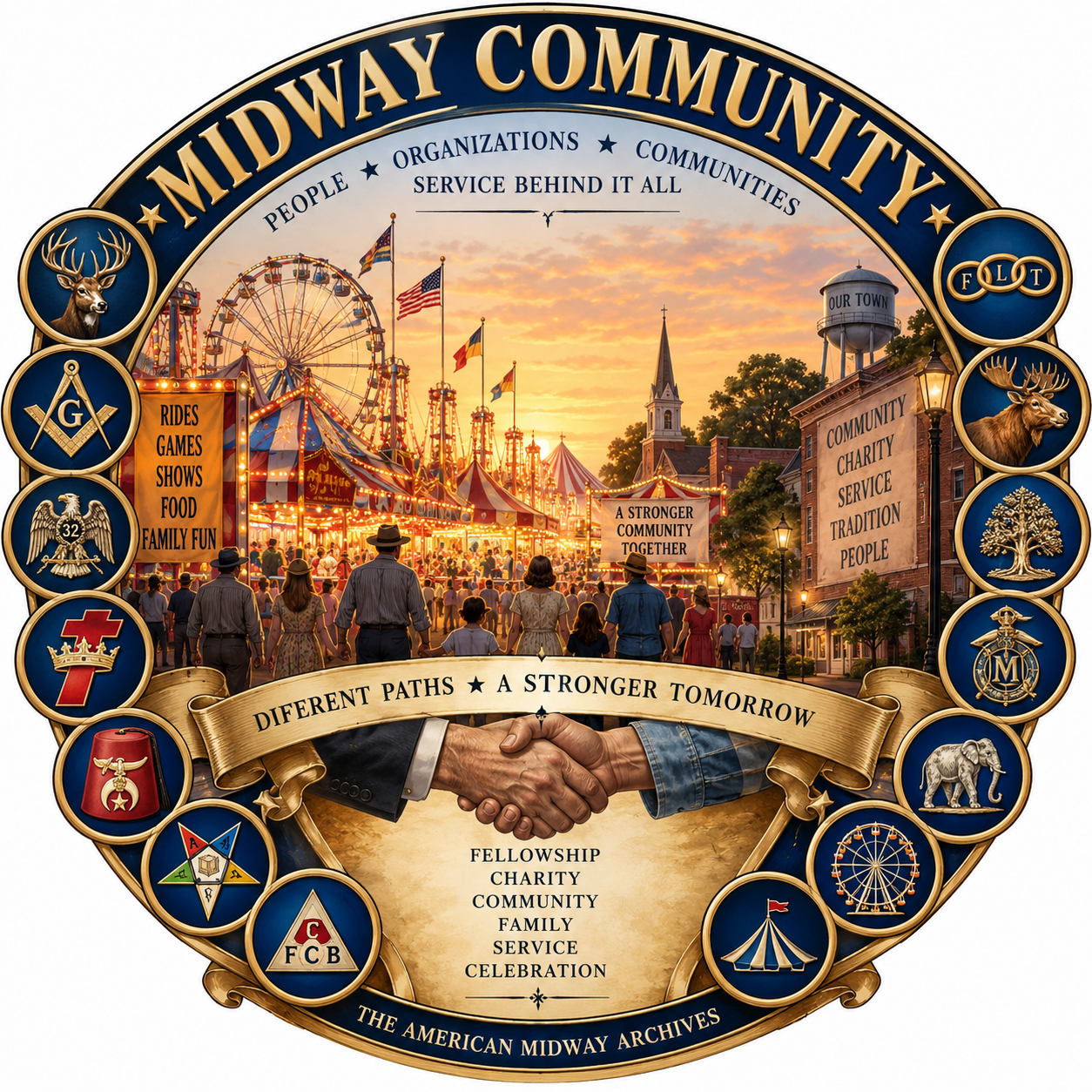
Learning to recognize the symbols matters. Fraternal emblems appear on lodge buildings, newspaper advertisements, programs, photographs, jewelry, badges, watch fobs, funeral notices and gravestones. Identifying a symbol can provide the clue that connects a showman or showwoman to another part of their community life.
Understanding the American midway therefore requires more than knowing who owned the show or where the train traveled.
We must also ask:
Who welcomed the show into town?
Who sponsored the celebration?
What was the money being raised for?
What organizations did the showmen themselves belong to?
And what did they give back to the communities that welcomed them?
This is the history of the Midway Community.
Fraternal Organizations and the Rise of the Street Fair
The relationship between fraternal organizations and the traveling carnival reaches into the formative years of the organized American midway.
Harold A. Bushea, writing retrospectively in The Billboard in 1925, described Frank W. Gaskill’s 1899 Chillicothe engagement as a street fair and carnival of the Elks. More significantly, Bushea described the carnival itself as becoming a popular means by which fraternal organizations and charitable committees could raise funds.
Contemporary records show that this was not an isolated arrangement. In 1901, the Canton Carnival Company contracted to furnish attractions for an Elks carnival at Champaign, Illinois, with the Elks sharing in the week’s receipts.
Period Billboard listings repeatedly identify Elks carnivals, Odd Fellows carnivals, and other lodge-sponsored street fairs. A 1901 listing, for example, included both an Odd Fellows’ Carnival and Street Fair in Kentucky and an Elks’ Carnival and Street Fair in Illinois.
By 1918, The Billboard was explicitly listing civic, military, and fraternal organizations among the groups supporting carnival engagements.
These relationships became part of the business structure of the traveling midway.
More Than a Booking
A carnival appearing under the auspices of a lodge was not necessarily evidence that the carnival owner belonged to that organization.
That distinction matters.
Throughout The American Midway Archives, organizational connections are identified according to what the historical evidence actually establishes:
Personal Membership — the showman or showwoman belonged to the organization.
Sponsorship or Auspices — an organization sponsored or helped present a carnival, circus, street fair or celebration.
Professional Relationship — a showman or company contracted with an organization to provide entertainment.
Charitable or Community Service — an event or activity raised funds or provided services for a charitable or community purpose.
Leadership or Service — a person held office or performed documented work within an organization.
One individual may have had several of these relationships. They should not be treated as interchangeable.
Fraternal, Civic & Charitable Organizations
The organizations below appear throughout the history of the American midway. This collection will continue to grow as additional biographies, obituaries, advertisements, contracts, route reports and photographs are added to the Archive.
Benevolent and Protective Order of Elks
The Elks appear remarkably early in the development of the organized American carnival.
Frank W. Gaskill’s history is already intertwined with Elks-sponsored street fairs. The Archive’s Gaskill research identifies the 1898 Canton Elks street fair as an important proving ground preceding the traveling organization that opened at Chillicothe the following year.
Period sources demonstrate that Elks lodges across the country used carnivals and street fairs as community events and fundraising enterprises. That relationship makes the Elks particularly important to the Archive’s study of the Street Fair Years.
About The Organization: Benevolent and Protective Order of Elks (B.P.O.E.)
About: Founded in New York in 1868, the Elks grew from a group with strong theatrical roots into a national fraternal organization centered on fellowship, benevolence and service. That theatrical beginning is particularly relevant to our Archive: the original group included actors and entertainers.
Look for: Elk head, often incorporated into a formal B.P.O.E. emblem. The elk itself is the easiest historical recognition marker.
Archive significance: Street fairs, carnival sponsorship, fundraising, community events and personal affiliations.
Archive connections currently identified:
Frank W. Gaskill; Canton Carnival Company; additional showmen and companies to be added as their records are reviewed.
Freemasonry
Masonic affiliations appear frequently in the lives and obituaries of people connected with entertainment and outdoor show business.
For the Archive, those references are more than genealogical details. They may help document a person’s friendships, community standing, funeral traditions, charitable activity and relationships beyond the midway.
The Archive will record the specific Masonic body and documented degree or office whenever the source provides it, rather than reducing every affiliation simply to “Mason.”
Related bodies documented separately may include the Scottish Rite, Knights Templar and Shrine.
About The Organization: Freemasonry
About: A longstanding fraternal tradition organized through local lodges, emphasizing moral and ethical development, fellowship, charity and service. The three symbolic-lodge degrees are Entered Apprentice, Fellowcraft and Master Mason.
Look for: Square and Compasses, frequently with the letter G. This is the most widely recognized Masonic symbol. Historical Masonic material can contain many additional symbols, so we should not identify Masonic membership from an isolated beehive, eye, star, etc. alone.
Archive significance: Personal membership, lodge leadership, funerals, community standing, charitable service and connections to related Masonic bodies.
Scottish Rite
Scottish Rite affiliation will be recorded when specifically documented.
Because Masonic affiliations can involve different bodies, degrees and offices, the Archive will preserve the terminology used by reliable records rather than infer one affiliation from another.
About The Organization: Scottish Rite
About: A branch of Freemasonry through which Master Masons may pursue additional degrees and teachings. For our purposes, it is important to record Scottish Rite affiliation separately rather than treating every Masonic reference as identical.
Look for: Double-headed eagle. For the Southern Jurisdiction, official Scottish Rite material documents double-headed-eagle marks associated with the 32° and 33°.
Archive significance: Record the actual degree or distinction when documented—especially the 33°—without inferring it.
Knights Templar
Knights Templar affiliations occur in historical obituaries and community records and will be documented independently from other Masonic affiliations.
A 1925 Billboard obituary already preserved in the Archive provides an excellent example of why this matters: the deceased was described in connection with Masonic bodies and the Elks, while the funeral was conducted by a Masonic lodge and the Elks and Knights Templar participated as escorts.
One obituary can therefore reveal an entire network of community relationships.
About The Organization: Knights Templar
About: A Masonic-related organization that appears frequently enough in historical obituaries and funeral notices that it deserves its own identification entry.
Look for: We should add the exact historically appropriate Templar emblem once we document the period/version represented in our material rather than putting a modern logo on the page and assuming it applies to every era.
Archive significance: Membership, funeral participation, commandery affiliations and community relationships.
Shriners
The relationship between show business and Shrine-sponsored entertainment became particularly important in the twentieth century.
Circuses presented in connection with Shrine organizations created an intersection among professional showmen, entertainment, fraternal life, fundraising and charitable service.
This will become one of the larger areas within Midway Community as the Archive documents the careers of Irving J. Polack and later showmen.
About The Organization: Shriners
About: Established by Freemasons in the 1870s as a fraternity emphasizing fellowship and later becoming particularly associated with philanthropy. In 1922 the organization established the hospital system now known as Shriners Children’s.
Look for: The unmistakable red fez with black tassel and the crescent-and-scimitar emblem. The emblem also incorporates a sphinx and five-pointed star.
Archive significance: Shrine circuses, charitable fundraising, children’s programs, personal affiliation and professional relationships between Shrine organizations and showmen.
Archive connections currently identified:
Irving J. Polack; Polack Bros. Circus; additional documented showmen and organizations to be added.
Order of the Eastern Star
The Archive will also document the participation of women in Masonic-related organizations, including the Order of the Eastern Star, whenever documentary evidence establishes those connections.
This is particularly important because organizational affiliations found in women’s obituaries may preserve information about community involvement that is absent from conventional accounts of carnival history.
About The Organization: Order of the Eastern Star (O.E.S.)
About: A fraternal and charitable service organization within the Masonic family, centered on fellowship, service and charitable work.
Look for: The distinctive five-pointed Eastern Star. Its five Star Points have their own symbolic associations and colors.
Archive significance: Especially important when documenting women and families in the midway community whose organizational lives may otherwise disappear from carnival histories.
Knights of Pythias
The Knights of Pythias appear repeatedly in the larger world in which carnivals operated.
Contemporary evidence demonstrates the organization’s direct connection with carnival activity. In 1902, for example, a large Knights of Pythias gathering in San Francisco included a street carnival held under Pythian auspices.
The Archive will document both personal affiliations and carnival engagements associated with Pythian lodges, keeping those two forms of evidence distinct.
About The Organization: Knights of Pythias (K. of P.)
About: Founded in Washington, D.C., in 1864 by Justus H. Rathbone, the Knights of Pythias is a non-sectarian fraternal organization built around the principles of Friendship, Charity and Benevolence and the story of Damon and Pythias.
Look for: Historical Pythian insignia can vary, so for our page I want us to use a period-appropriate documented emblem, rather than grab a contemporary graphic and risk teaching the reader the wrong visual marker for a 1900 obituary or photograph.
Archive significance: Personal affiliations, lodge-sponsored carnivals, street fairs, benefits and community events.
Archive connections currently identified:
Frank W. Gaskill; additional showmen and companies as documented.
Independent Order of Odd Fellows — I.O.O.F.
Odd Fellows organizations also sponsored fairs, carnivals, and community events.
Period Billboard material documents Odd Fellows carnivals during the early street-fair period, and a 1905 report discussed plans for a carnival benefiting an Odd Fellows’ orphan home.
The I.O.O.F. therefore belongs not simply in a list of affiliations but within the history of community sponsorship and charitable fundraising through outdoor amusement.
About The Organization: Independent Order of Odd Fellows (I.O.O.F.)
About: A fraternal organization in the United States dating to 1819, built around Friendship, Love and Truth and a tradition of mutual assistance and humanitarian service.
Look for: Three interlocking links, commonly containing the letters F–L–T for Friendship, Love and Truth. This is an excellent recognition symbol for our purposes.
Archive significance: Street-fair and carnival sponsorship, charitable benefits, personal membership and lodge connections.
Archive connections currently identified:
Frank W. Gaskill; Rutherford-related engagements; others to be added.
Loyal Order of Moose
Moose organizations appear in both showmen’s personal histories and carnival engagements.
The Archive already holds a 1913 newspaper item announcing a Moose Carnival featuring the J. Frank Hatch shows, including the work of the lodge committee and preparations for the engagement.
That is exactly the type of evidence this page is intended to connect.
About The Organization: Loyal Order of Moose
About: Founded in Louisville in 1888, the Moose developed as a fraternal organization combining fellowship, mutual assistance and community service. Its later work prominently included care for children at Mooseheart and senior members at Moosehaven.
Look for: Moose head / moose imagery and the organization’s name or initials. Because its graphic identity has changed over time, we should use a historical emblem appropriate to the period we’re discussing rather than substitute today’s branding.
Archive significance: Carnival sponsorship, benefits, community relationships and showmen’s personal affiliations.
Archive connections currently identified:
Frank W. Gaskill; J. Frank Hatch; Rutherford-related engagements; additional connections to be documented.
Order of Woodmen
Woodmen organizations appear in the personal and community histories of early showmen.
As those records are processed, the Archive will distinguish personal membership from events merely held under Woodmen auspices.
About The Organization: Woodmen / Woodmen of the World
About: The organization now known as WoodmenLife was founded in Omaha in 1890 as a fraternal benefit organization, combining financial protection for members and families with community and charitable activity.
Look for: This is another one where period matters. The modern organization uses completely different branding from what our early showmen would have known. We should use a verified historical Woodmen emblem or artifact from the appropriate period.
Archive significance: Personal membership, mutual-benefit networks, charitable activity and community connections.
Archive connections currently identified:
Frank W. Gaskill; additional connections to be added.
Maccabees
Maccabee organizations also appear in the engagement history of traveling shows.
These records will become part of the larger effort to reconstruct the local organizations that contracted with, sponsored, and helped support traveling carnival companies.
About The Organization: Maccabees
About: A fraternal benefit society that became part of the enormous network of mutual-aid organizations present in American communities during the period when the traveling carnival was developing. Historical records use terminology such as Tent for local organizations; women’s Maccabee organizations also became significant.
Look for: Period Maccabee badges and insignia rather than a modern approximation. The Smithsonian holds surviving Knights of the Maccabees lodge badges, which gives us a good artifact-based avenue for identifying the imagery actually worn by members.
Archive significance: Sponsorship, personal affiliation, mutual-benefit activity and community events.
Archive connections currently identified:
Rutherford Greater Shows and related engagements; additional evidence to be added.
Fire Departments
Volunteer and municipal fire departments belong in this history as well.
They were not fraternal lodges in the same sense as the Elks or Knights of Pythias, but they were important community institutions and appear in carnival sponsorship, benefit activity and in the personal lives of show people.
The Archive will document both carnival engagements benefiting fire organizations and showmen who performed documented service within fire departments.
About The Organization:
Showmen’s Clubs and Associations
The midway eventually created organizations of its own.
Showmen’s clubs and associations provided fellowship, professional networks, mutual assistance, social events, charitable programs and places where people whose lives were spent traveling could maintain a community of their own.
These organizations also sponsored activities for children and families and supported charitable causes.
The Showmen’s League of America and other showmen’s organizations will be documented here as their connections to individual showmen and showwomen are established.
Irving J. Polack, for example, belongs in this history through his documented leadership in the Showmen’s League.
Giving Back to the Communities They Played
The history of the midway cannot be told only through money earned at ticket boxes.
Show people also participated in the communities around them.
Benefits, children’s events, holiday programs, hospital fundraising, lodge activities, and local charitable projects appear throughout show history.
Sometimes the public remembers the institution or event but no longer remembers the people who raised the money, organized the entertainment, or did the work.
The American Midway Archives seeks to preserve both.
Because the story is not simply that a carnival came to town.
It is also the story of what happened between the show and the town while it was there.
Following the Connections
As the Archive grows, organizational connections will be linked in both directions.
A biography may lead a reader from a showman to the Elks, Shriners, Knights of Pythias, Odd Fellows or another organization.
The organization history will, in turn, lead readers back to the showmen, showwomen, carnival companies and events through which that relationship can be documented.
That fulfills one of the governing principles of The American Midway Archives:
No page should exist in isolation. Everything connects to something else.
A Living Community Record
This page is not intended to be a finished list.
Every obituary may reveal another lodge.
Every route report may reveal another sponsoring committee.
Every contract may identify another community relationship.
Every photograph may preserve a benefit, children’s event, lodge gathering, or civic partnership whose significance was almost lost.
When those connections are found, they will be added here—and connected back to the people whose lives made them part of the history of the American Midway.