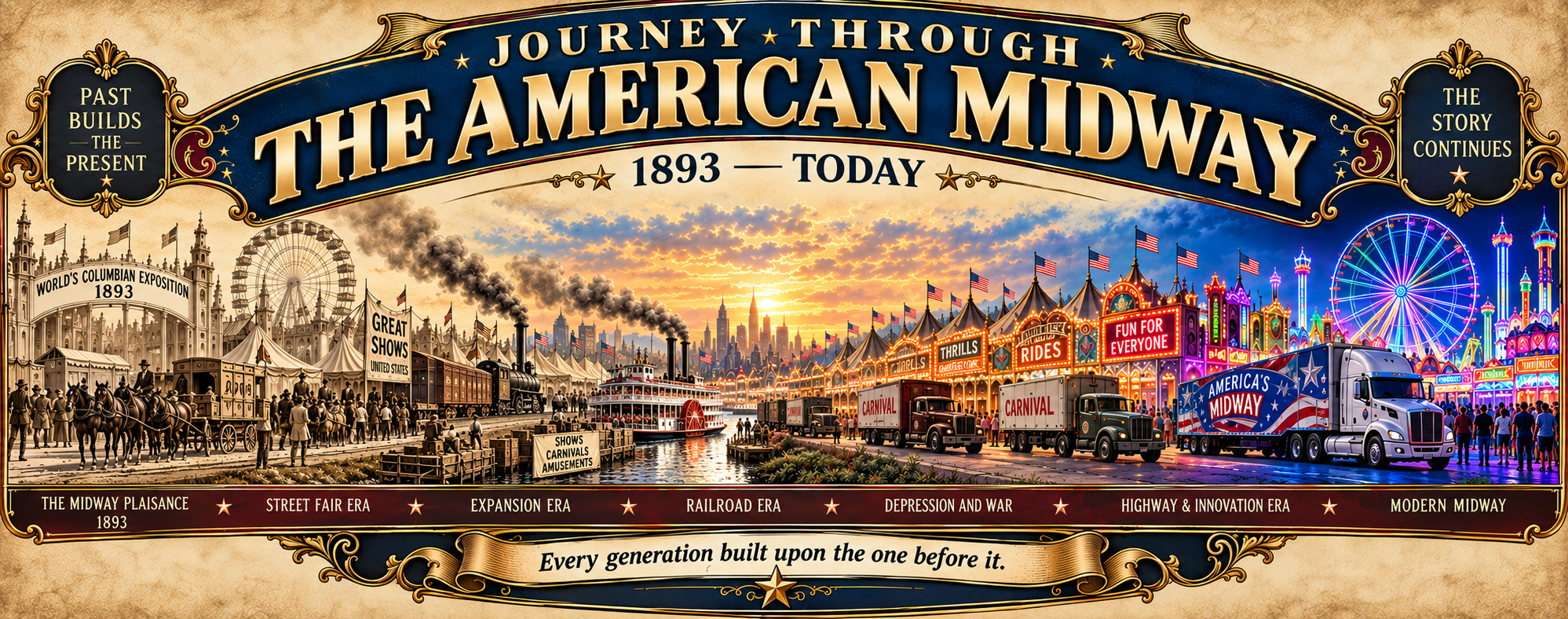
“Every generation built upon the one before it. Every journey began with a single step. Every story became part of the American Midway.”
Travel through the history of the American Midway—from the Midway Plaisance of the 1893 World’s Columbian Exposition to the traveling carnivals and family-owned shows that continue the tradition today.
The American Midway did not emerge fully formed. Each generation inherited what the generation before it had learned and then faced new problems of its own. Transportation changed. Technology changed. America changed. The midway changed with it.
These eras explore the people, companies, transportation, innovations, attractions and circumstances that shaped the industry—and what showmen had to become in order to survive, adapt and keep the show moving.
Street Fair Era
The American Midway takes to the road.
In the years surrounding and following the 1893 World’s Columbian Exposition, performers, concessionaires, attraction owners and emerging showmen began carrying entertainment into street fairs, celebrations, fairs and communities across America. They were learning how to organize, advertise, transport and operate what would become the traveling midway.
The Early Pioneers (1893–1910)
- Otto Schmidt
- Frank W. Gaskill
- Frank C. Bostock
- Adolph Seeman
- George Jabour
- C. J. Sturjis
- Buffalo Bill
- J. S. Berger
- Johnny J. Jones
- Will Heck
The Expansion Era (1911–1920)
The American Midway grows into a national industry.
The Railroad Era (1921–1930)
The age of larger railroad carnivals and spectacular attractions.
Through Depression and War (1931–1945)
How showmen and their families persevered through some of America’s most difficult years.
Growth and Innovation (1946–1980)
Television, highways, modern rides, and changing America.
The Modern Midway (1981–Present)
The continuing story of today’s traveling amusement industry.