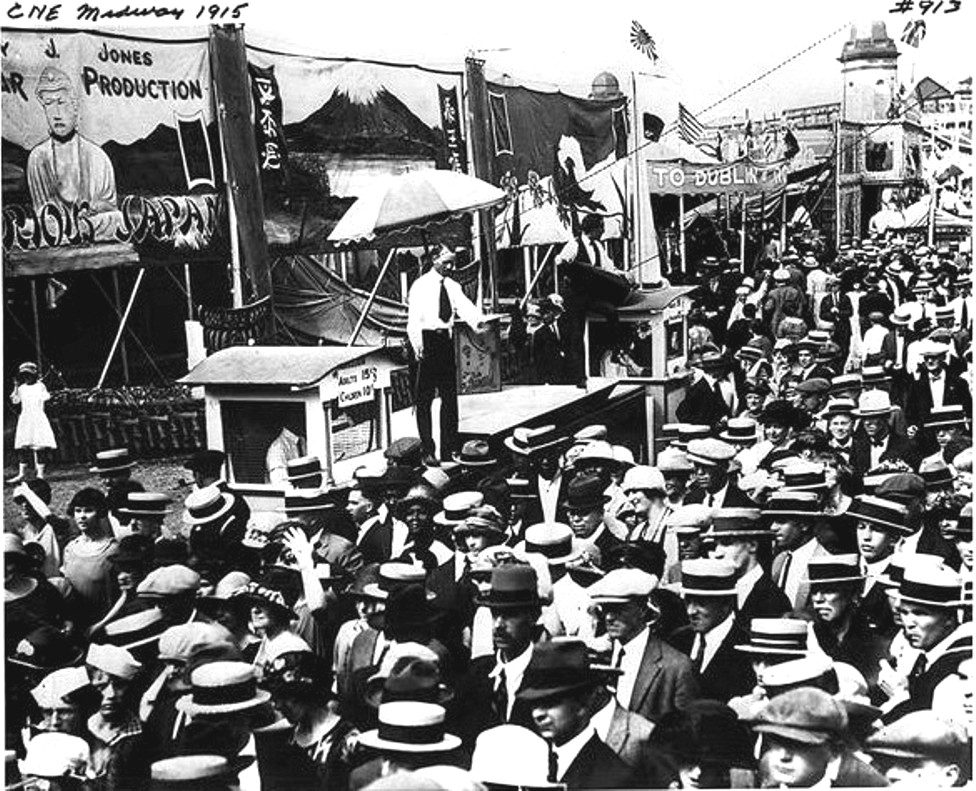
JOHNNY J. JONES – “The Mighty Monarch of The Tented World”
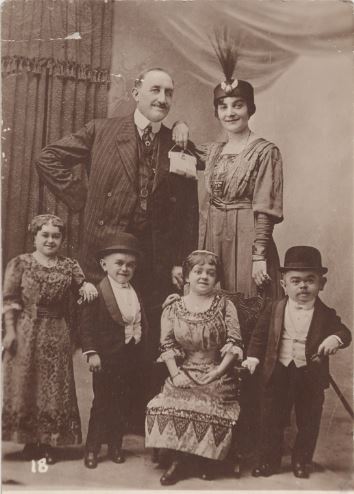
L.-R: Princess Marguerite, the Doll Lady, 29 inches high, age 22; Prince Denison, the Most Human Diminutive, 27 inches high, age 19 (France); Duchess Leona, The Beautiful Minature, 31 inches high, age 23; The Noble Adrien Mab, 27 inches high, age 41, Circa 1904
- 1895 Cane Rack Booth
- 1899 Johnny J. Jones Ferris Wheel Company
- 1901 Johnny J. Jones Combination Shows
- 1902 Jones – Allen (Tom Allen) Combination Show
- 1903 Columbus Carnival Company with Bert Hoss (formed a partnership in the spring of 1903 – only played two dates)
- 1903 Jones Carnival Company with Zimmerman
- 1905 Jones And Adams (James Adams) Exposition Shows With Johnny J. Jones Big Trained Wild Animal Exhibition as the featured act
- 1906 Johnny J. Jones Exposition & Trained Wild Animal Exhibit
- 1910 Johnny J. Jones Exposition Shows
Doc’s Midway Cookhouse Collection

Johnny J. Jones
The Mighty Monarch of the Tented World
“Johnny’s Coming.”
For a time, those words meant everything.
They meant the midway was on its way—
organized, respected, and unlike anything else, traveling the country.
They meant Johnny Jenkins Jones.
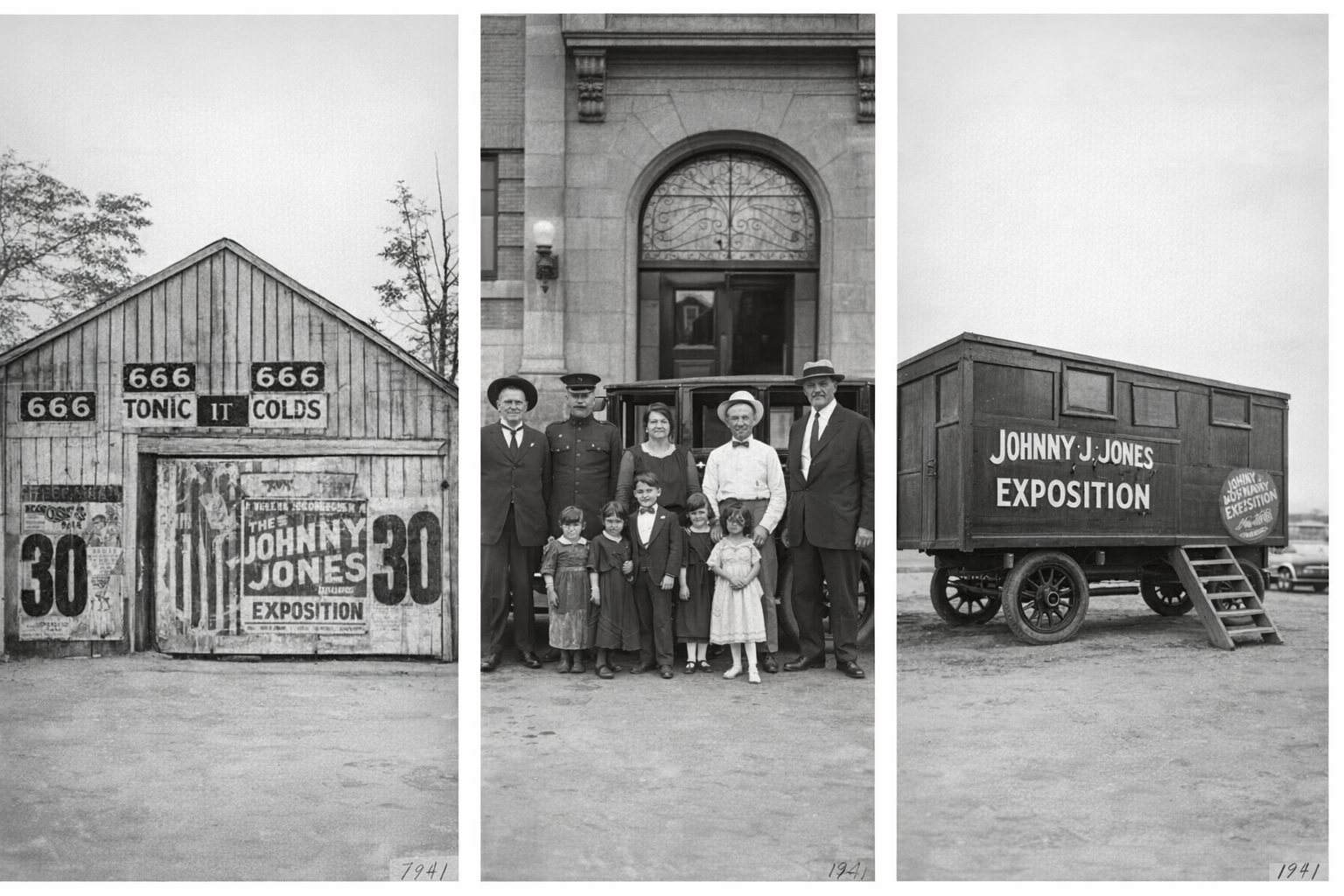
Overview
Johnny J. Jones was one of the most influential carnival showmen of the early 20th century. From humble beginnings in the coal fields of Pennsylvania, he built one of the largest and most respected traveling midways in America.
Known for discipline, innovation, and a commitment to clean entertainment, his show became a standard others struggled to match.
Early Life (1874–1895)
Born June 8, 1874, in Arnot, Pennsylvania, Jones was raised in nearby Du Bois. His early years were shaped by labor—working in coal mines as a boy before moving to the railroads, where he sold newspapers and goods as a “news butcher.” He managed to save $2700.00, a small fortune for those days.
It was there he learned the rhythms of travel, people, and opportunity.
The Turning Point (1895–1907)
Jones entered the amusement business in 1895 with a cane rack concession.
It succeeded.
Instead of spending his earnings, he reinvested them.
He purchased a miniature railroad
Then built his own Ferris wheel
This moment marked his transformation:
From concessionaire → to ride owner → to show builder
By 1907, he had formed Johnny J. Jones Exposition Shows & Trained Wild Animal Exhibition
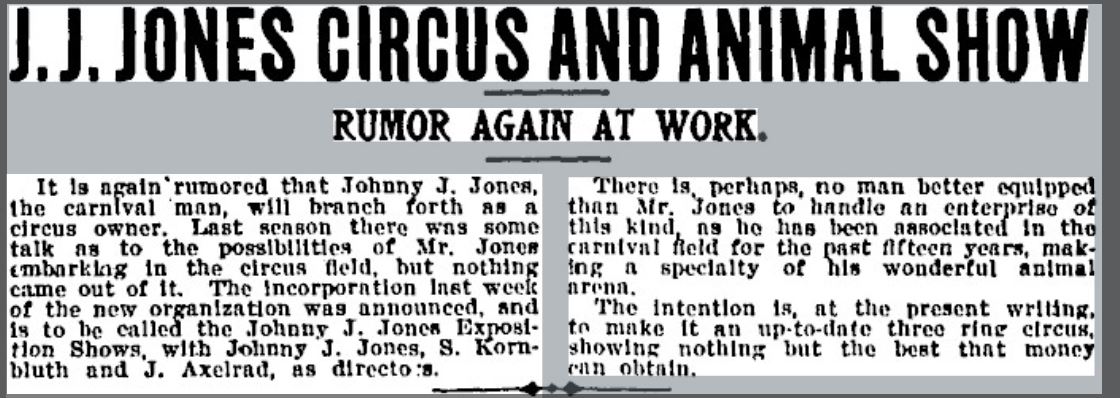
Building a Moving Empire (1907–1920s)
Jones expanded steadily:
- Carolinas and Southern circuits
- Into the Midwest
- West of the Mississippi by 1916
- Canada and major exhibitions
By the 1920s:
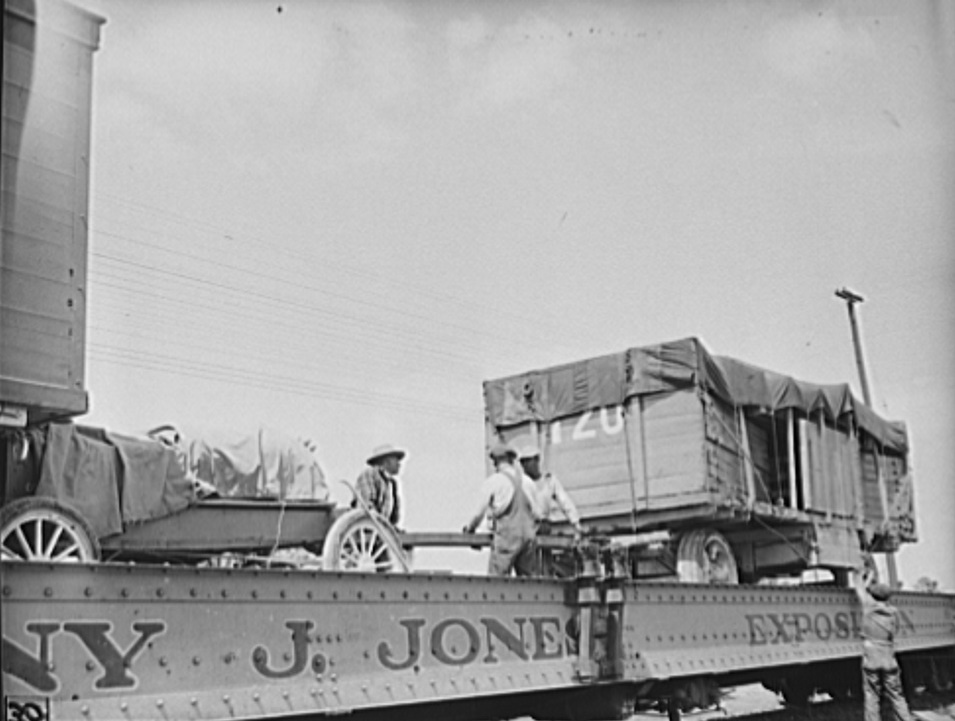
- ~50 steel railroad cars
- ~100 wagons
- Second in size only to Ringling Bros. and Barnum & Bailey Circus
His show was not just traveling. It was a city on rails . . .
Railroad Operations of the Johnny J. Jones Exposition
How a Pennsylvania showman built one of the greatest railroad carnivals in American history
Johnny J. Jones did not simply operate a traveling show — he operated a railroad‑driven logistical machine that rivaled the great circuses of his era. At its height, the Johnny J. Jones Exposition moved on a special train of 40–50 cars, making it one of the largest railroad carnivals ever assembled.
A Show Built for the Rails
Jones understood early that the railroad was the key to reaching the booming industrial towns of the Northeast and Midwest. Unlike wagon shows or truck shows, a rail‑based exposition could jump hundreds of miles overnight and arrive ready to open the next day.
His train typically included:
- Flats for rides, shows, and heavy equipment
- Baggage cars for concessions and canvas
- Stock cars for animals and transport wagons
- Sleeper cars for workers and performers
- Private cars for management and office staff
Every piece of equipment — from the Ferris wheel to the cookhouse — was designed to be broken down, loaded, and tied down with precision.
The Jones Loading System
Former showmen described Jones’s loading process as “military.” Crews were divided into teams, each responsible for a specific ride or department. The order of loading never changed. The train was packed the same way every time, car by car, so that unloading at the next town was fast and predictable.
This discipline allowed the Exposition to:
- close at midnight
- tear down through the night
- load by dawn
- and be rolling by morning
It was a masterpiece of early 20th‑century logistics.
Railroad Relationships
Jones maintained strong working relationships with the major railroads of the Northeast, especially the lines serving Pennsylvania, Ohio, Michigan, and New York. Railroads valued him because:
- he paid on time
- he moved large volumes
- he brought crowds to towns along their routes
In return, they provided siding space, switching crews, and priority handling — essential for a show of his size.
Arrival in a New Town
When the Exposition arrived, the train was often met by:
- local police
- city officials
- newspaper reporters
- curious townspeople
The unloading itself became a spectacle. Rides rolled down ramps, wagons clattered across the lot, and the midway rose from the ground in a matter of hours. For many towns, the arrival of the Jones train was the unofficial start of summer.
Pennsylvania Roots, National Reach
Although Jones traveled widely, Pennsylvania remained the heart of his operation. His train returned to DuBois year after year, and the railroads of the state became the backbone of his routing. From these lines he built a network that carried the Exposition across the Midwest and Great Lakes region.
A Legacy on Steel Rails
By the 1920s, the Johnny J. Jones Exposition was recognized as:
- the largest railroad carnival in the United States
- the most efficiently run
- and one of the safest and cleanest shows on the road
His mastery of rail logistics allowed him to compete with — and often surpass — the great circuses of his day.
Even after his death in 1930, the show continued to operate on rails for several years, a testament to the system he built.
A Showman Who Controlled His Story
Jones understood visibility.
Through The Billboard, he:
- Promoted his routes
- Managed his reputation
- Responded to criticism
- Positioned his show as a leader
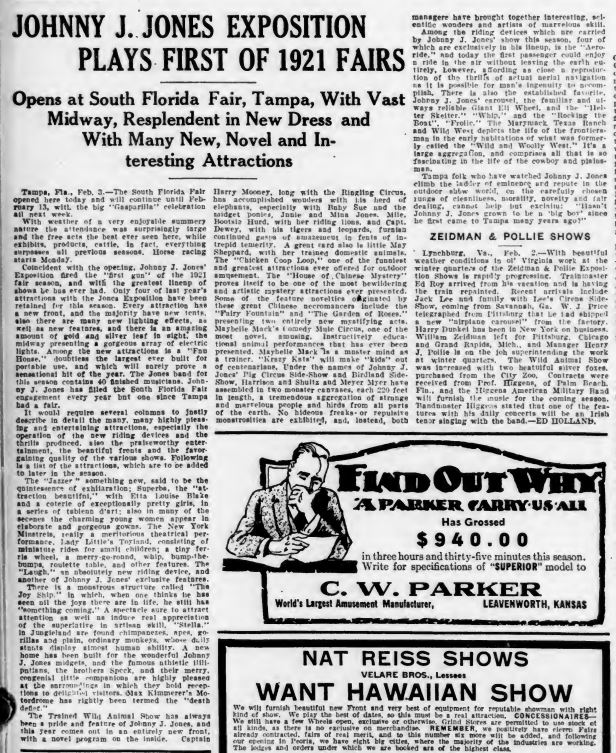
Long before modern branding. Jones made sure his name stayed current
Reputation: “The Sunday School Show”
His midway became known for:
- Clean concessions
- Orderly layout
- Family-friendly environment
- Respect from communities and officials
This was not accidental. It was intentional
Cultural Reach
Jones’ show attracted national attention.
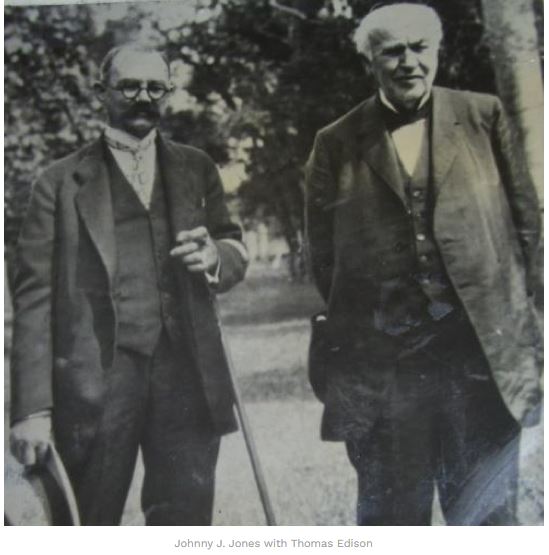
Visitors included figures such as Thomas A. Edison, reflecting the growing cultural significance of the midway.
He also brought international spectacle to American audiences, including exotic animals and unique attractions sourced globally.
His Hometown, Du Bois – The Capital of the World
Despite his success, Jones never left home behind. His wagons carried the words: “Du Bois – The Capital of the World”
Each summer, he returned—leading his band to his mother’s grave, where music and remembrance drew thousands. When in town, he would visit the family burial plot at the Rumbarger Cemetery and would make substantial donations to the DuBois Hospital.
He gave back to the community, supporting charities and helping fund a children’s hospital ward.
Struggles and Humanity
Jones’ life was not without difficulty.
Years of travel, the loss of his first wife, Sarah, responsibility, and constant pressure led to struggles with alcohol. He later renounced drinking and sought change, reflecting a deeply human side often missing from historical accounts.
The Final Years (1930)
The Great Depression placed enormous strain on even the largest shows.
On December 25, 1930, Jones died in his private railroad car in DeLand, Florida at age 56.
A Showman’s Farewell
His funeral drew:
- Showmen
- Fair officials
- Civic leaders
Two trucks were needed for flowers.
Sixty automobiles followed in procession.

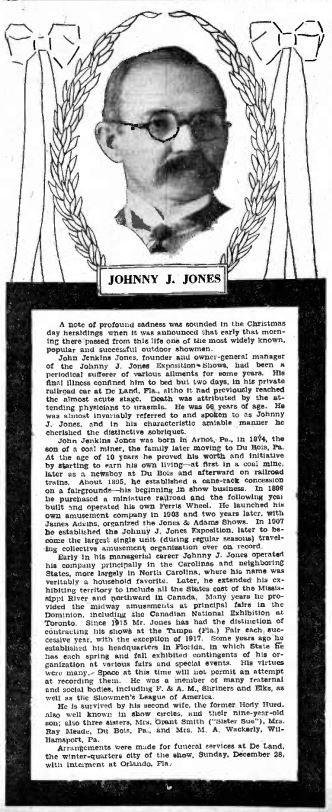
It was not just a funeral. It was recognition.
Carey Hand Funeral Home records, December 25, 1930 to February 4, 1931.
Orlando, Dec. 29. Two funeral services were held yesterday for Johnny J. Jones, showman and carnival owner. The first was conducted at DeLand, where he died Christmas day and the second was held at his grave in a local cemetery.
Hundreds crowded the Elks club at DeLand and heard the eulogy delivered by an Elks orator and many of them accompanied the body to Orlando.
The rites here also were attended by hundreds who saw Sydney Johns, of Saskatchewan, Canada, circle above the cemetery in an airplane which he flew from Chicago for the purpose of honoring his friend of many years.
An escort of DeLand policemen accompanied the procession to the outskirts of that city and another escort of officers met the hearse when it reached Orlando.
The Bradford County Telegraph
Starke, Florida
Friday, January 2 , 1931 page 8
Legacy
Jones helped define what the American midway could be:
- Organized
- Scalable
- Trusted
- Respected
Though time has moved on, his influence remains in the structure of the modern carnival.
A Note of Dedication
These pages are created in honor of the showmen who built the midway…
and in memory of David “Doc” Rivera —whose passion for preserving their stories continues through this work.
Closing Reflection
For a time, when the banners read “Johnny’s Coming”… the midway had arrived. And then others took over Johnny J. Jones Exposition and carried it through to 1950. IN 1930, there was the Depression, and the 1930 season had been disastrous for Johnny J. Jones Exposition. Jack Murray, Mrs. Johnny J. Jones (“Hody” Jones), Eddie J. Madigan, and Joseph Redding (former manager of JJJ, then with Rubin and Cherry) were named directors for the show. Murray became the managing director responsible to the court for the show and handling the finances. Redding was the general manager. Mrs. Jones was the secretary. Vernon Kohrn, treasurer. Murry and Magigan each owned one-third. Murray and Madigan were bought out, and Mrs. Johnny J. Jones had complete ownership, including the show name, but with all her attention on the litigation, Johnny J. Jones Exposition had lost several spots and had to scramble for the 1933 Season. Mrs. Johnny J Jones and as her son Johnny Jr got older, operated the traveling carnival with hired management until the year 1947, when John Jr. went to college, selling Johnny J Jones Exposition to Harold Paddock & Morris Lipsky.
The IRS sold the entire operation in March of 1951. One of the buyers of the four-train flats and a steel boxcar was James E. Strates, who came to the Clearfield County Fair, from 1948 until 1994.