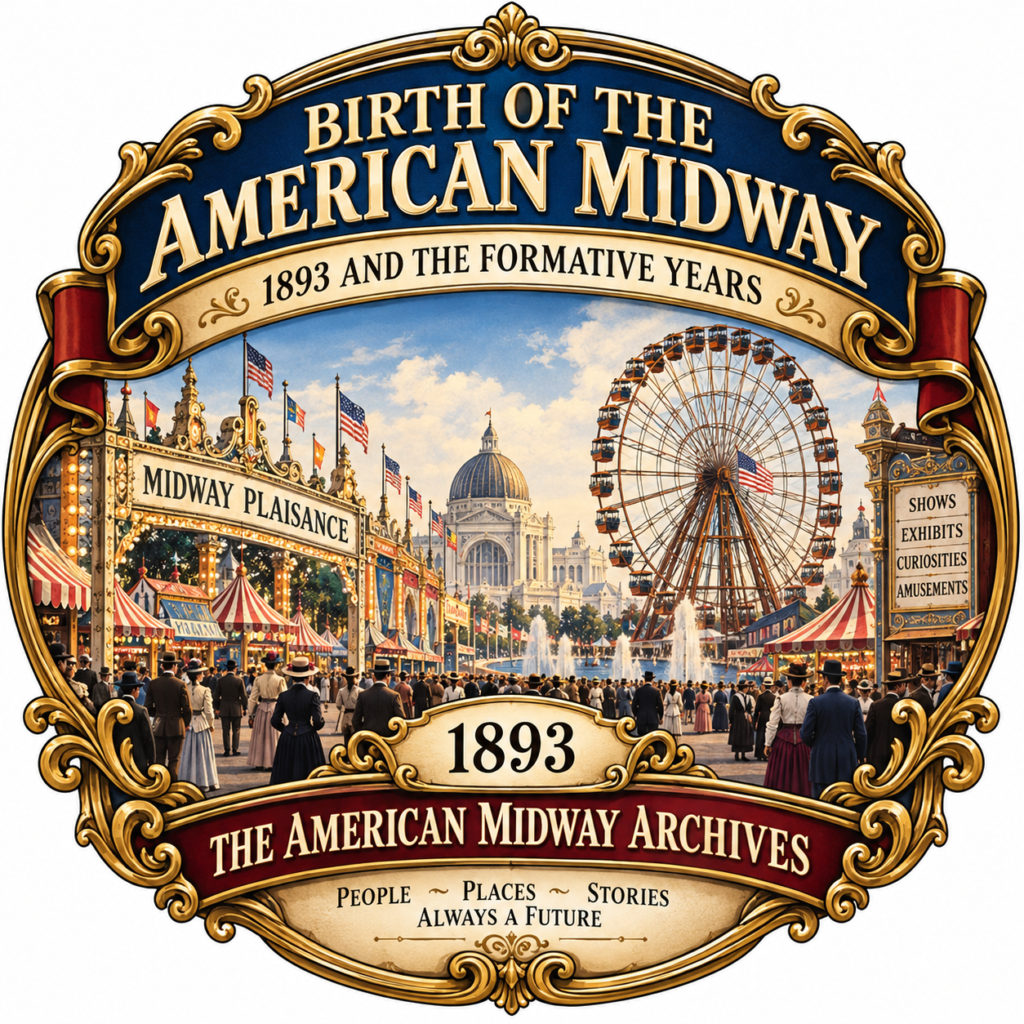
Early Pioneers — 1893–1900
From the Midway Plaisance to a Traveling American Industry
The American traveling carnival did not appear fully formed in a single year, nor was it the creation of one person.
Its beginnings were a process.
Long before an organized carnival could arrive aboard its own train, unload its equipment, raise its show fronts, light the midway and open for business, traveling entertainers, circuses, fairs, theatrical companies, animal exhibitions, concessionaires and independent showmen were already taking entertainment to the American public.
But in 1893, something extraordinary happened in Chicago.
At the World’s Columbian Exposition, an unprecedented concentration of entertainment, commerce, technology, architecture, performance and spectacle came together along a mile-long strip of land known as the Midway Plaisance.
The American Midway Archives begins the story here—not because everything that became the American carnival was invented in Chicago, but because the Midway Plaisance brought together many of the people, ideas, attractions, technologies, and business practices that would become important to what followed.
And when the World’s Fair closed, the story did not end.
It began to move.
Before There Was a Traveling Carnival
Americans were already accustomed to entertainment on the move.
Circuses traveled. Theatrical companies toured. Wild West exhibitions moved from city to city. Animal shows, medicine shows, minstrels, panoramas, magic-lantern exhibitions and individual performers followed established routes. State and agricultural fairs provided gathering places where entertainment could be presented to large crowds.
What had not yet developed into a mature American industry was the organized traveling midway—a collection of different attractions operating together and capable of moving repeatedly from engagement to engagement as a coordinated amusement enterprise.
That required more than attractions.
Someone had to book the dates.
Someone had to advertise them.
People and equipment had to be transported.
Shows had to be erected and dismantled.
Performers had to be housed and fed.
Power had to be supplied.
Tickets had to be sold.
Local agreements had to be negotiated.
Money had to be collected and divided.
And all of it had to be done again in the next town.
The history of the American carnival is therefore not simply the history of rides and shows.
It is the history of learning how to move a midway.
1893 — Chicago
The World’s Columbian Exposition
The World’s Columbian Exposition created an enormous temporary city of exhibition halls, international displays, machinery, commerce, art, agriculture, and new technology.
Beside the great exposition grounds was something different.
The Midway Plaisance had originally been a wooded strip connecting Jackson and Washington parks. The official 1893 guide described it as one mile long and six hundred feet wide. For the Exposition, the former country lane was transformed into a broad boulevard surrounded by villages, theaters, bazaars, restaurants, workshops, architectural reproductions and amusement attractions.
The official guide called it:
“The Highway Through the Nations.”
Visitors could encounter international villages and performers, hear music, watch artisans work, eat and drink, purchase souvenirs, enter theaters and exhibitions, see animals, experience electrical effects and ride the great Ferris Wheel.
Some attractions were free.
Others charged separate admission.
Entertainment, technology, commerce and spectacle operated beside one another.
The Midway was not a traveling carnival.
But it demonstrated on an extraordinary scale what could happen when many different forms of amusement were assembled together and presented to a mass audience.
[Explore: The 1893 World’s Columbian Exposition →]
[Explore: The Midway Plaisance →]
A Midway Was Also a Business
The Midway Plaisance was not simply something to look at.
It was an entertainment marketplace.
The official guide listed attractions individually and told visitors what each would cost. A visitor might enter one attraction for ten cents, another for twenty-five cents, pay fifty cents for something more elaborate, visit free commercial exhibits and restaurants, and spend additional money on food, merchandise, and souvenirs.
That mixture is important to the history that followed.
The Midway brought together:
- paid attractions;
- free attractions designed to draw visitors;
- theaters and performances;
- music;
- restaurants and cafés;
- merchandise;
- souvenirs;
- demonstrations;
- animal exhibitions;
- mechanical amusement;
- architecture and show fronts;
- electric illumination and effects;
- advertising and promotion.
It also required managers, concessionaires, performers, musicians, artisans, cooks, ticket sellers, laborers and many others whose work made the spectacle possible.
Behind the entertainment was an organization of people.
That, too, would become part of the American midway.
Technology Became Entertainment
The Exposition occurred during a period of extraordinary technological change, and on the Midway some of that technology became part of the show.
The Ferris Wheel transformed engineering into an amusement experience.
The Electric Scenic Theater used incandescent lamps and electrical controls to create changes from dawn to twilight and a stormy night before an audience.
At the Ice Railway, mechanical refrigeration became part of an attraction.
At Libbey Glass Works, visitors watched skilled workers manufacture glass and could purchase products and souvenirs.
A captive balloon offered visitors another kind of experience—an aerial view available for a separate admission.
The significance was larger than any single attraction.
The public could experience technology.
In the developing outdoor amusement business, innovation would repeatedly become spectacle.
The People Behind the Midway
Buildings did not create the Midway.
People did.
Entrepreneurs financed concessions. Managers operated attractions. Performers entertained. Musicians played. Craftspeople demonstrated their work. Restaurant operators fed visitors. Merchants sold goods. Laborers built and maintained structures. Agents, promoters and advertisers brought people through the gates.
People had also come to Chicago from many parts of the world.
The language used to describe some of them in 1893 reflected the racial, colonial, and anthropological attitudes of the period. Contemporary guidebooks and newspapers sometimes described human beings as curiosities or as parts of an “exhibit.”
The American Midway Archives preserves those historical sources without adopting their language or assumptions as our own.
Whenever the evidence allows us to do so, we look beyond the attraction name to recover the individual:
Who were you?
That question remains at the center of this Archive.
October 1893 — The Fair Closes
Eventually the lights went out.
The World’s Columbian Exposition closed.
Contracts ended. Temporary structures faced demolition, sale or removal. Performers and workers departed. Concessionaires moved on. Equipment changed hands.
But the people who had participated in the great amusement experiment did not disappear.
Neither did the public’s memory of the Midway.
Evidence from the months following the Exposition shows pieces of its physical amusement world entering the marketplace. In January 1894, for example, the buildings comprising the German Village—including its castle, village houses, restaurant halls, concert pavilions and market booths—were advertised for private sale, either together or separately.
The question was no longer merely:
What had Chicago built?
It was becoming:
What could be done with it next?
[Continue: After the Fair — What Happened to the Midway? →]
The Midway Begins to Move
There was no single road leading away from Chicago.
That is one of the most important parts of this history.
People, attractions, and ideas moved in different directions.
Some Midway-style attractions were assembled again at another exposition.
In January 1894, the California Midwinter International Exposition opened in San Francisco, carrying the exposition-and-midway idea westward and providing another important chapter in the movement of amusement forms beyond Chicago.
[Explore: 1894 California Midwinter International Exposition →]
Elsewhere, individual attractions and performers continued to travel.
Communities began reproducing their own versions of “Midways.”
Entertainment entrepreneurs experimented with grouping attractions together.
And in Chicago, Otto Schmidt pursued another possibility:
What if a collection of Midway-style attractions could be organized specifically to travel?
With financial backing associated with theatrical manager Josiah “Jo” Baylies, Schmidt became involved in an ambitious early effort to take a collective amusement enterprise onto the road—the Chicago Midway Plaisance Amusement Company.
It was difficult.
Transportation was difficult.
Construction was difficult.
Weather was difficult.
Financing was difficult.
Keeping hundreds of people moving and working together was difficult.
Some experiments failed.
Others changed form.
But every attempt helped answer the question that stood between the fixed exposition midway and the later American carnival:
How do you make the midway portable?
[Explore: Otto Schmidt →]
[Explore: Josiah “Jo” Baylies →]
[Explore: Chicago Midway Plaisance Amusement Company →]
More Than One Beginning
The history becomes distorted when the development of the American carnival is reduced to a single inventor, a single company, or a single date.
The evidence reveals something more interesting.
The Midway Plaisance provided one important gathering point.
Afterward came experimentation.
Attractions moved.
People formed new partnerships.
Companies were organized and reorganized.
Ideas were adapted to different locations and audiences.
The Garden City Amusement Company, Midway Fair Company and other early enterprises belong to this developing story and must be followed individually rather than collapsed into a single founding legend.
[Explore: Garden City Amusement Company →]
[Explore: Midway Fair Company →]
At the same time, another powerful development was occurring across American communities:
the street fair.
When the Midway Came to Town
By the closing years of the nineteenth century, street fairs, agricultural fairs, civic celebrations and events sponsored by local organizations provided opportunities for groups of attractions to appear before large audiences.
The environment was different from Chicago.
The midway had to adapt.
Early showmen could not simply transport an entire World’s Fair village from place to place.
Show fronts and structures might be built from materials obtained locally. Crews could be sent ahead. Contracts had to be negotiated before the show arrived. Newspaper advertising, billposting, parades and promotion helped create a crowd.
The organization behind the entertainment became increasingly important.
Among the people who would help demonstrate this transition was Frank W. Gaskill.
Gaskill’s experience in business, theaters, hotels, advertising, and civic entertainment preceded the organized carnival company that followed. His early operations provide valuable evidence of the transition from locally constructed street-fair entertainment toward increasingly organized and portable carnival companies.
The midway was learning how to travel.
[Continue: The Street Fair Years — When the Midway Came to Town →]
[Explore: Frank W. Gaskill →]
From an Idea to an Industry
The American traveling carnival that emerged in the years that followed required developments that the 1893 Midway itself did not possess.
Equipment became increasingly portable.
Advance departments became more sophisticated.
Managers divided responsibilities among departments.
Routes were planned.
Contracts were negotiated.
Advertising preceded the show into town.
Transportation improved.
Companies incorporated.
Show fronts evolved.
Electrical power and lighting changed the nighttime midway.
Rail transportation eventually allowed enormous carnival organizations to move people, animals, wagons, rides, shows, and equipment over great distances.
Later still, trucks and improved highways changed the industry again.
None of that happened overnight.
That is why the American Midway Archives treats 1893–1900 as a period of beginnings, experimentation and transition rather than a single moment of invention.
The Birth of the American Midway
The 1893 Midway Plaisance did not contain the finished American traveling carnival.
It contained something equally important:
possibility.
It demonstrated the appeal of gathering many forms of entertainment, spectacle, food, commerce, technology and performance in one place.
Then the Fair closed.
People carried their experience elsewhere.
Attractions were sold, moved, rebuilt and reimagined.
Entrepreneurs experimented.
Showmen learned.
Communities invited entertainment into their streets and fairs.
Methods that failed were abandoned or changed.
Methods that worked were repeated.
Gradually, the midway became something that could travel.
And once it could travel, it could become an industry.
Continue the Journey
1893 World’s Columbian Exposition
The world surrounding the Midway and the extraordinary exposition that brought millions of visitors to Chicago.
[Explore the 1893 World’s Columbian Exposition →]
The Midway Plaisance
Enter the mile-long amusement district of villages, theaters, restaurants, performers, technology and spectacle.
[Explore the Midway Plaisance →]
After the Fair
Follow the people, attractions, buildings, and ideas after the World’s Columbian Exposition closed.
[Explore After the Fair →]
1894 California Midwinter International Exposition
See how Midway-style entertainment quickly reappeared at another major American exposition.
[Explore the California Midwinter International Exposition →]
Chicago Midway Plaisance Amusement Company
Follow Otto Schmidt, Jo Baylies, and an early attempt to organize a collective Midway-style amusement enterprise for travel.
[Explore the Chicago Midway Plaisance Amusement Company →]
Garden City Amusement Company
Follow another branch in the development of organized American amusement companies.
[Explore the Garden City Amusement Company →]
Midway Fair Company
Continue tracing the companies and people experimenting with organized traveling amusement.
[Explore the Midway Fair Company →]
The Street Fair Years
Follow the midway into American streets, agricultural fairs, celebrations, and civic events as organization and portability began transforming outdoor amusement.
[Continue to The Street Fair Years →]
Experience the Early Midway
History tells us when the American midway developed. But understanding the carnival also means understanding how it worked.
Follow the show behind the scenes—from advance advertising and transportation to setting the lot, opening the midway, feeding the show and tearing everything down for the move to the next town.
Sources & Resources
- John J. Flinn, Official Guide to Midway Plaisance, Otherwise Known as “The Highway Through the Nations” (1893). Issued under authority of the World’s Columbian Exposition and revised through August 10, 1893. Primary contemporary source for the organization, attractions, admission prices, and descriptions of the Midway Plaisance.
- Contemporary World’s Columbian Exposition newspapers and advertising. Used by The American Midway Archives to document how attractions and competing entertainment were advertised to the public and to follow people, properties, and attractions during and after the Exposition.
- World’s Columbian Exposition ephemera, tickets, guides, photographs and visual materials in the Rivera/American Midway Archives research files. Individual provenance is recorded or researched wherever possible.
- The Billboard historical carnival and midway accounts. Retrospective accounts are identified as later recollections rather than treated as contemporary 1893 documentation.
- New York Clipper. Contemporary and near-contemporary amusement-industry reporting used to follow early showmen, attractions, companies and routes.
- William H. McKennon, A Pictorial History of the American Carnival. Important later carnival history and recollection source; used with attribution and compared with contemporary evidence wherever possible.
- David “Doc” Rivera, Sawdust Trails — History of the Traveling Carnival, unpublished documentary script. American Midway Archives. Rivera’s unfinished documentary provides an important narrative and research foundation for the Archive’s continuing study of the development of the American traveling carnival.
- American Midway Archives research files. Court records, corporate documents, directories, genealogical records, newspapers, trade publications, photographs, advertisements, and other evidence are used to reconstruct the people and companies of the early midway.
Research Notes & Open Questions
Research into the birth of the American midway remains ongoing.
The American Midway Archives does not consider publication the end of research. New newspapers are digitized, unidentified photographs are recognized, family collections surface, court and corporate records are located, and sources that are presently inaccessible may become available later.
Among the continuing research questions for this era are:
- Which later carnival showmen, managers, agents, performers and concessionaires can be documented as having worked at, participated in or personally visited the 1893 World’s Columbian Exposition?
- How and when did “Midway,” derived from the proper name Midway Plaisance, become widely used as a generic American term for an amusement area?
- Where did individual 1893 Midway attractions, performers, equipment and concessionaires go after the Exposition closed?
- What relationships connected the early collective amusement companies that appeared during the 1890s?
- How did transportation, construction methods and advance organization change between the fixed exposition midway and the increasingly portable carnival companies at the end of the century?
- What additional contemporary evidence can clarify the histories of the Chicago Midway Plaisance Amusement Company, Garden City Amusement Company, Midway Fair Company and related enterprises?
These questions remain open by design.
The history presented here reflects the evidence currently available to the American Midway Archives and will be expanded or corrected when stronger documentation is discovered.
American Midway Archives
Every story matters.
The American Midway Archives preserves the people, companies, attractions, equipment, photographs, documents, and stories that built the American midway.
You are not alone in remembering them. We’ll leave the light on.