Traveling Carnival History, American Circus History, Sideshow History, and more . . .

Old Carnival Photos, Carnival History, Circus History, Traveling Shows

  • HOME
    • The Heart of The American Midway
  • THE AMERICAN MIDWAY SHOWMEN
    • Biographies of the American Midway
      • Biographies
        • Early Pioneers (1893 – 1905)
        • Expansion Era (1905 – 1915)
        • Growth of The Railroad Shows (1915 – 1929)
        • The Golden Age of The American Midway (1930s – 1950s)
        • Television, Highways, and Change of American Midways (1950s -1970s)
  • CARNIVAL COMPANIES
    • Carnival Company Library
  • COLLECTIONS
    • Old Carnival Midway Photos
    • History Of The American Carnival
      • Traveling Carnivals In America Brought Earliest Form of Entertainment
        • Patent Medicine Shows
      • Traveling Show History
        • How The Traveling American Carnival Grew
      • Railroad History Of Carnival and Circusl Trains
  • AMERICAN MIDWAY RESEARCH LIBRARY
    • How To Use The Research Library
  • ABOUT
    • A Brief Bio
      • Doc’s Midway Art
    • CONTACT
You are here: Home / Carnival History / BEGGS SHOW WAGON COMPANY

BEGGS SHOW WAGON COMPANY

January 30, 2026 By Editor

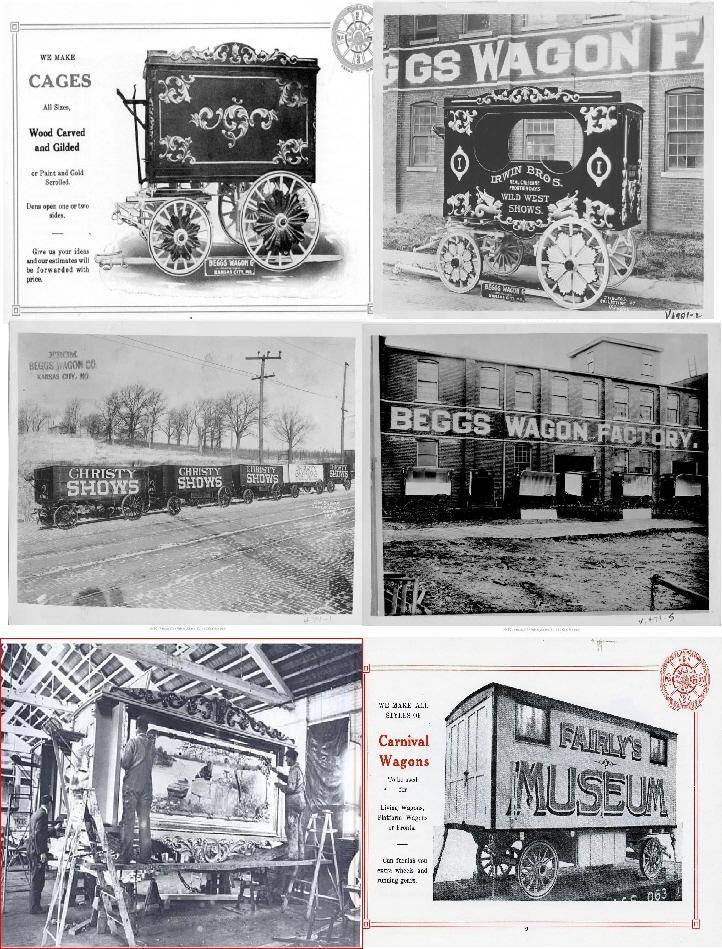
Circus and Carnival Wagons Built by Beggs Company
alt=Circus and Carnival Wagons Built by Beggs Company

By the end of the 1800’s, wagon builders abounded. Many of these companies specialized in particular wagon designs such as stage coaches, surreys, farm wagons, and even dining car wagons. It was back in the late 1880’s when the Beggs Wagon Company, then at Creston, Iowa, commenced making show wagons. Their line had been Farm and Freight Wagons since 1875.

The F. J. Taylor Circus wintered in Creston with a large circus and menagerie (an Overland Show). Needing new, heavier wagons, they inquired if Beggs could design and build them. A complete outfit of wagons, including baggage, cage, and advance wagons were contracted and subsequently built for the show. For many years following, wagons were built for large and small circuses and carnivals of about every description by the Beggs company.

Show wagons called for a particular type of construction, and therefore, there were never many manufacturers in the country that built them.
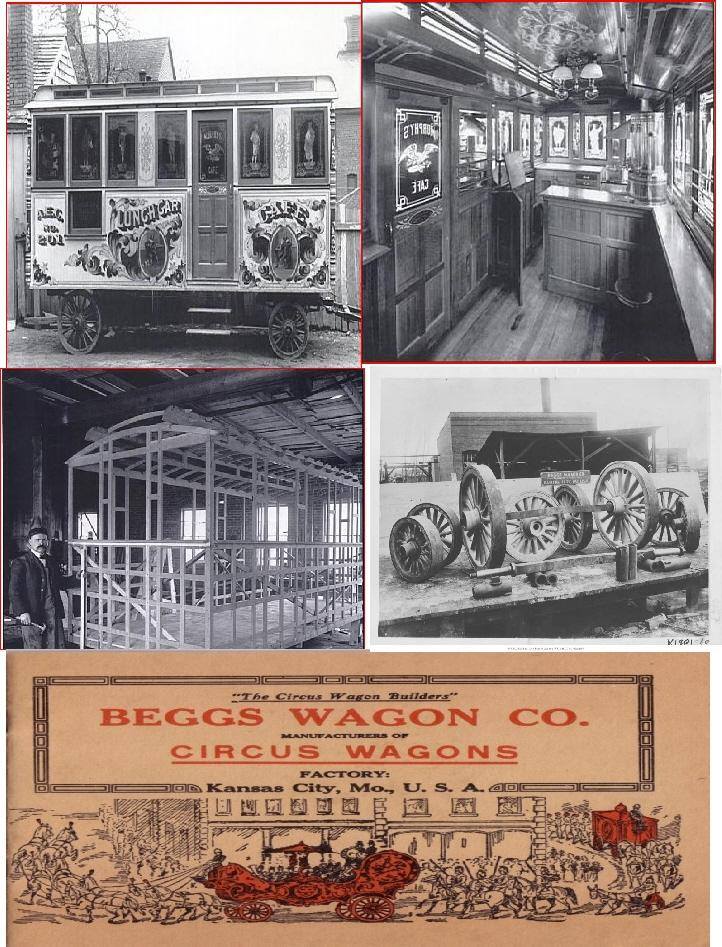
Many details of construction, unknown to the layman but appreciated by the showman, were a “must standard” on show and circus wagons. The wagon tongues had to be wide and strong. Some were 12″ to 14″ wide at their backs and several inches thick to stand the strain of being pulled out of the thick, gooey mud they would encounter on some lots. The removal of a single hitch pin allowed the wagon tongues to be removed and placed under the wagons en-route. They had to have thick, strong hold back chains and goose necks at the front to hook on extra lead bars for additional horse teams. If seats were on the top of the wagons, they had to be jump seats, able to be collapsed, and needed the top risers to hinge down to reduce top clearance. Drivers’ foot-boards had to be made to hinge down, falling against the body to reduce space in loading the cars. Possum bellies were built under many to add additional loading space. Large, strong steel rings were placed at the front and rear corners of the wagon bodies for hooking on snatch teams and unloading from flat cars. Cages were made to have barred ventilators properly placed front and rear to allow ventilation when cages were closed up en-route. In addition, cage wagons needed inside rear barred doors, slide up feed doors, slide clean outs, etc. All heavy wagons were equipped with drag shoes that hung underneath their bodies by chains for emergency braking.
The Beggs Wagon Company, by then relocated to Kansas City, Mo., after 1904, was completely equipped to manufacture every item needed in the production of any kind of circus or carnival wagon. A lumber yard of many thousands of feet of seasoned lumber was always on hand. Complete woodworking machinery and a large blacksmith department for the fabrication of all steel and iron parts were maintained. Wheel making machinery included machines for every operation from the driving of spokes, turning of wheels, pressing of boxing, etc., and a large hydraulic press, for shrinking or setting of the metal tires from the light spring wagon size to the largest baggage wagons. Craftsmen and artisans, experienced in wood carving, artistic painting, and decoration, were among the many talented and experienced personnel.
The Beggs wagon business prospered until production of wagons was discontinued about 1923.
alt=Circus and Carnival Wagons Built by Beggs Company


The Beggs letterhead slogan always read: “Made a little better than seems necessary”.
Filed Under: Carnival History

Midway Slideshow

Books About Gibtown

  • Gibtown, Through The Camera Lens of Diana Phillips Book – Gibtown, Through The Lens of Diana Phillips

Carnival

  • John Dillinger's Car An short story in the site Sideshow World

Carnival and Circus Links

  • Buckles Blog Spot An interesting site full of carnival and circus information and photos from the past to present day.
  • Carousel World worlds leading collectors, and foremost authorities on antique carousels and carousel art.
  • Circus Blog A cool site loaded with historical information about the circus and carnival.
  • Circus Historical Society Circus Historical Society
  • Greater Show World….The Voice Of Show Business 1936 An amazing old magazine full of articles describing the Show Business Midways of 1936.
  • http://dick-dykes.blogspot.com/ A nifty site filled to the brim with cool videos, great stories and pictures.
  • National Carousel Association Index of North American Carousels
  • Sawdust and Spangles This is a great site for circus historians and circus model builders.

Carnival and Circus Museums

  • C. W. Parker Carousel Museum 1901 C.W. Parker Carousel Museum
  • Carnival World Museum American Carnival History Cultural Museum
  • Circus Historical Society Circus Historical Society
  • Circus World Museum Baraboo Wisconsin Circus History Museum
  • Herschell Carrousel Factory Museum Carousel History Museum
  • The Carousel Museum Carousel History Museum
  • The Ringling Circus Museum Ringling Cuircus Museum

Carnival and Circus Research Sources

  • Billboards Online at World Radio History Billboards from 1894 – 1921
  • New York Clipper New York Clipper Trade Paper – Carnival, Circus, Theater, Music
  • Old "Billboard Magazines" From A Bygone Era Old Billboard Magazines Starting From 1942 Featuring Ads And Stories From The Sawdust Trails Of The Times

Carnival Organizationa and Associations

  • Gibtown Bike Week I I S A and Showman’s Shrine Club sponsors Gibtown Bike Week Annually
  • International Independent Showmen's Association International Independent Showmens Associationor IISA, Gibsonton

Carnival, Circus, and Gibsonton Images

  • USF Showmen's Museum Photograph Collection USF Digital Collection of images portraying the life and times of American Carnival and Circus including Gibsonton

Side Show History

  • Carny World A link to some sideshow history and “freaks”
  • Shocked And Amazed Sideshow Seen Through A Modern Lens
  • Side Show World A site for great stories, photos and links to the backend of the midways of America
  • The Human Marvels A collection of historical “freaks” and brief discriptions of their histories

USF Showmen's History

  • Showmen's Oral History Project Andy Huse, assistant librarian in USF Tampa Library Special Collections, interviews association members involved in circuses, rodeos, and carnivals. Home-based in Gibsonton, Florida, the Showmen’s Association interviews document the careers of various sho
  • USF Showmen's Museum Photograph Collection USF Digital Collection of images portraying the life and times of American Carnival and Circus including Gibsonton

Magic Acts

Magicians Hilliar and Houdini

Midway Magic Acts – Houdini and Hilliar Were Great Friends  William J. Hilliar was a magician and author who edited Billboard‘s “Magic and Magicians” page for many years. He was also close friends with Houdini. “That friendship will always stand out as one of the dominating factors in my life,” said Hilliar. In 1933, Hilliar […]

Carnivals

HAROLD A. BUSHEA

Early Carnival Contracting Agent, Manager, and General Director Harold A. Bushea belongs among the important figures of the formative American traveling midway not because his name appeared above the title of a famous carnival, but because he helped make the organization behind one of those early carnivals work. Before entering the carnival business, Bushea was […]

Carnival Movies

Showbiz And The Big Screen

Hollywood And The Midway Movies Come To The Tented World If you’re like me, you love old films that have anything to do with ‘The Biz’. Victor Mature is great in the 1959 classic: The Big Circus which is an example of a little known Hollywood gem. Elvis Presley in Roustabout features colorful scenes from the […]

Copyright © 2026 · Docs Midway Cookhouse · All rights reserved.