Adolph Seeman Biography (1852 – 1924)
- 1903 Robinson and Seeman Carnival Company
- 1904 Seeman Amusement Company
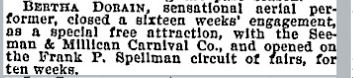
- 1904 Seeman – Millican Mardi Gras and Festival Company
- 1905 Seeman – Millican Mardi Gras Company
- 1915 Jarvis and Seeman Shows
Professor Adolph Seeman (July 28, 1852 – August 21, 1924) was a highly educated Swedish-born illusionist, civil engineer, and pioneering American carnival owner. He stands as a towering figure who bridged the golden age of 19th-century stage illusion with the birth of the modern mobile carnival midway.
Early Life & Engineering Beginnings
Born in Stockholm, Sweden, Adolph was a second-generation performer. He was the son of Baron Hartwig Seeman, the globally renowned “Emperor of Magicians”.
Rather than relying solely on stagecraft, Adolph pursued an extensive formal education in Sweden, Berlin, and Saxony, earning a degree in civil engineering. Following a brief period of military service in the Prussian Army, he joined his father’s international touring show. On May 19, 1880, the Seeman family—Hartwig, his wife Emma, their son Adolph, and daughter Marie—arrived in New York aboard the SS Gellert to conquer the American theater circuit.
In 1881, Adolph’s father, Baron Seema, brought his Magic show to Coney Island for the summer season. After the Coney Island season closed, they toured the larger cities of the United States with Adolf as manager of the troupe.
The Texas Tragedy & The Show’s Succession
In March 1886, while embarking on that major tour of the American Southwest, Baron Hartwig Seeman contracted a severe cold that rapidly turned into pneumonia. He died suddenly on March 25, 1886, in the remote railroad town of Kosse, Texas. Targeted by local rumors regarding the Baron’s legendary collection of royal jewels, the 26-year-old Adolph had to secure his father’s estate. His mother, Emma Seemann, retired to New York with the Baron’s assets, while Adolph stepped forward as the rightful successor to the family enterprise.
Early Life and Craft
Seeman’s early years from A Pictoral History of The American Carnival by Joe McKennon – Page 70
“Adolph Seeman was born in Stockholm, Sweden, on July 28, 1852. A son and a grandson of noted magicians. He went to school in Sweden, Berlin, and Saxony.
He acquired a degree in Civil Engineering. He then served his allotted time in the Swedish Navy and was discharged in 1874. Baron Seeman, his father, asked him to join the magic show as an assistant. In 1876, he helped transport a circus overland into Siberia and back with good financial returns.
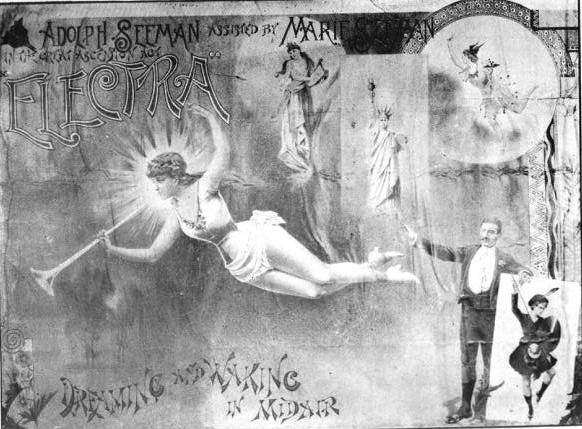
Known as Prof. Adolph Seeman the World’s Greatest Illusionist, known for “Electra” and the Great “Cremation”.
The Illusion of “Marie” and Electra
To maintain the wholesome, lucrative image of a “family act,” Adolph billed his primary stage assistant as his wife, “Marie Seeman.” In reality, official records later revealed that Adolph remained a lifelong bachelor; the real Marie Seemann was his biological sister, who did not perform the dangerous stunts.
The stage “Marie” served as the centerpiece for his most famous inherited illusions. This included “Electra,” a breathtaking levitation and suspension act framed with theatrical electrical bolts, and “The Great Cremation,” where Marie was seemingly burned to ashes on stage before the audience’s eyes.
Electra Poster
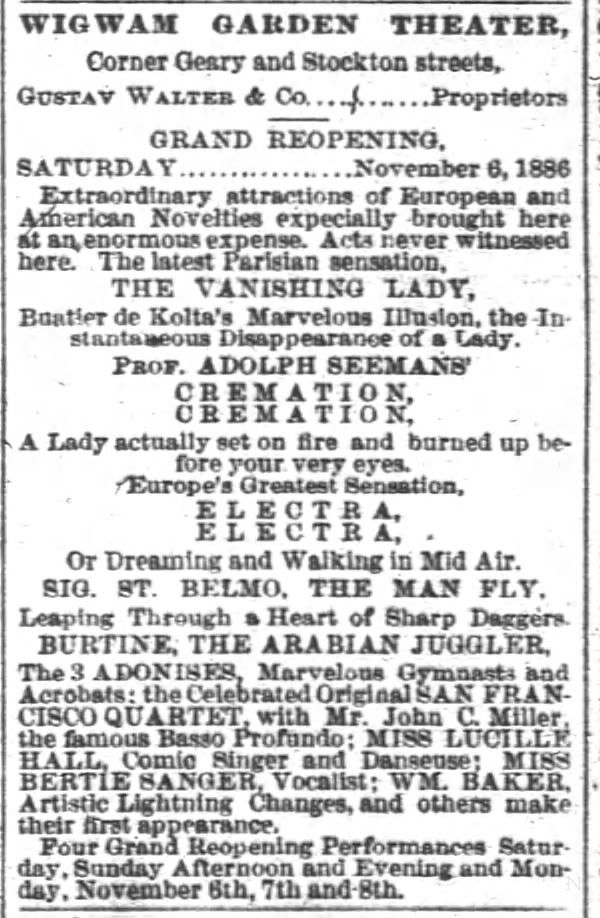
He billed himself as Adolf The Magician until 1893.
The Magician Who Built America’s First Crystal Maze
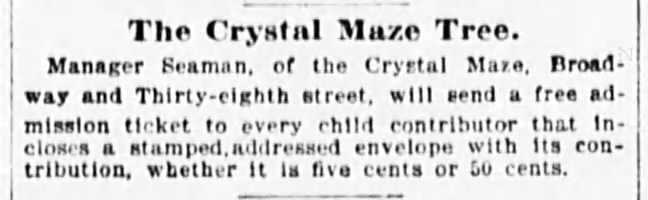
Adolph Seeman stands at the crossroads of illusion, architecture, and early American amusement. A German-born magician with a gift for mechanical design, he created the first Crystal Maze in the United States at Broadway and 38th Street — a mirrored labyrinth lit by electric bulbs, Moorish arches, and theatrical atmosphere. His work became a blueprint for the funhouses and glass houses that would later define the midway.
Inventing the Portable Crystal Maze (1893)
On April 19, 1893, Seeman opened America’s first commercial, permanent “Crystal Maze” at 38th Street and Broadway in New York City. The lavish hall featured massive, flawless sheets of European plate glass that Seeman had imported at a staggering cost of $25,000. At the time, Broadway was rapidly expanding northward, and Seeman chose this prime location to capture the massive foot traffic of theatergoers and tourists. While European inventors had played with glass structures, Seeman is credited with popularizing and cementing the term “Crystal Maze” in the American vocabulary. It was a lavish, permanent indoor pavilion rather than a standard traveling tent setup.
The Broadway Vandalism Scandal
- The Insurance Angle: Magic and carnival historians note that Seeman likely inflated that $25,000 figure significantly to the press for both insurance payout purposes and as a clever marketing stunt to make the attraction sound incredibly exclusive and valuable to the public. For comparison, a similar maze built in Kansas City that same year cost only $5,000.
- The Incident: In May 1893, a group of unruly visitors intentionally smashed four of the massive, expensive mirrors inside the labyrinth.
- The Quote: A frustrated Adolph Seeman was heavily quoted in contemporary newspapers, declaring to reporters, “The mirrors here cost $25,000, and we can’t afford to have them spoiled!”
When vandals shattered several mirrors a month later, Seeman weaponized the outrage in the newspapers for free publicity.
The Crystal Maze at Broadway & 38th Street
- First American mirrored maze
- Moorish pillars and arches
- Electric lighting is used as a theatrical device
- A sensory experience that influenced later amusement architecture
This maze became a sensation, drawing crowds who had never before encountered such an environment. Its design language would echo across the next generation of attractions.
Just a month after opening, the high-profile attraction made front-page news in New York due to a dramatic case of vandalism.

Recognizing the financial risk of stationary glass attractions, Seeman used his civil engineering background to redesign the maze. In 1893, he filed two distinct US patents mapping out a modular system of 45, 60, and 120-degree mirror panels. This allowed the heavy, fragile labyrinth to be easily bolted together, dismantled, and crated.
The Mirror Maze Patent Technicalities (1893)
- The Blueprint Secret: His May 1893 design relied on precisely configured mirror angles. He utilized combinations of 45, 60, and 120-degree angles to generate the specific illusion.
- The Disappearing Visitor: The math behind these angles created a bizarre effect: visitors could look into specific mirrors and see other lost guests, but could not see their own reflection in that specific glass plane.
- The “Attraction” Point: His blueprint labeled a specific point (O) near the exit (E). An object placed there appeared six separate times throughout the maze. This made the reward look right in front of the fairgoers, driving them crazy as they repeatedly walked into dead ends. [1]
Partnering with carnival builder Victor David Levitt, Seeman manufactured and leased these portable units to premier rail shows like the Rubin & Cherry Shows, cementing the mirror maze as a permanent staple of the American carnival midway.
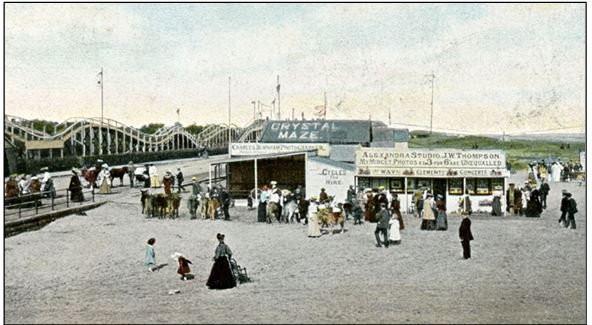
The Catalyst for Traveling Carnivals
Operating a stationary building on Broadway was highly profitable, but the real estate costs and the physical risk of stationary installations convinced Seeman that he needed to protect his asset.
Seeing how vulnerable his expensive glass was to city crowds, he spent the rest of 1893 drawing up blueprints to make the entire system modular. By October 1893, he had secured his federal patents for the portable Crystal Maze, allowing him to pack the mirrors safely into padded railroad crates and take his Broadway sensation on the road to safer, highly lucrative regional state fairs.
In the spring of 1898, he was approached by the Elks Club of Zanesville, Ohio, asking for information about street fairs. He produced a street fair for them, which was copied by other Elks in Ohio. Frank Gaskill was a visitor and took notes. Seeman always claimed that this was the first Elks Lodge Street Fair anywhere.
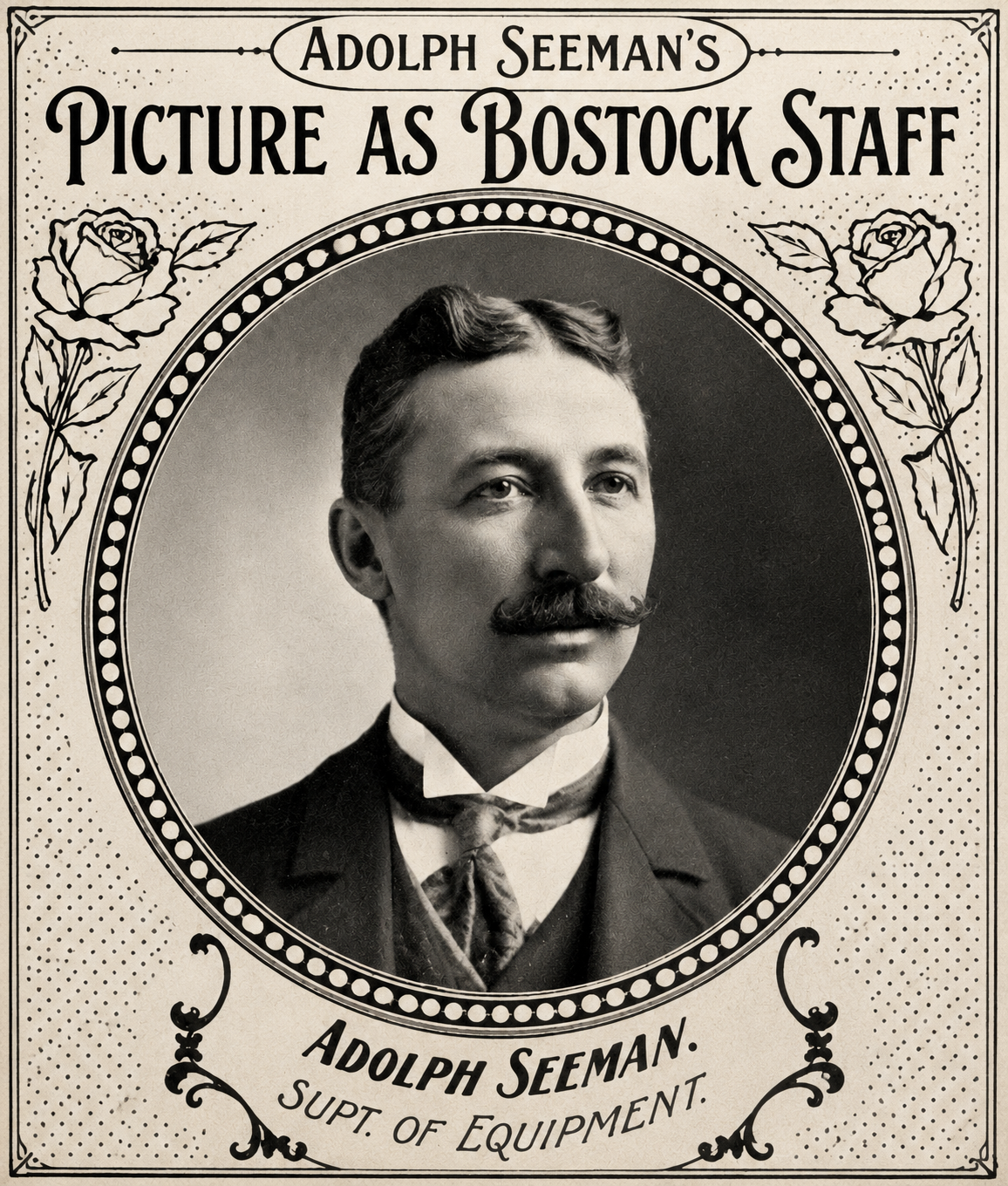
He then went into the carnival business exclusively. He was partnered with many showmen, including Bostock, Jarvis, Millican, and Leavitt, in midway operations. He was the manager of the Dan Robinson Show and always managed the shows in which he was a partner. He joined the new Rubin & Cherry Shows as a builder and designer. His designing and building of show fronts, shows, and wagons have been given credit for the success of the show. He was a genius at design and construction.
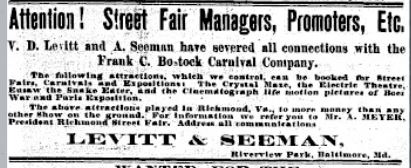
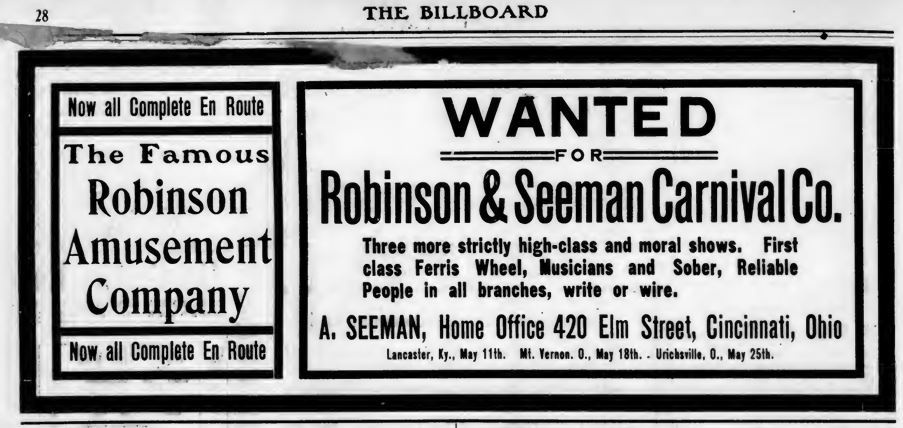
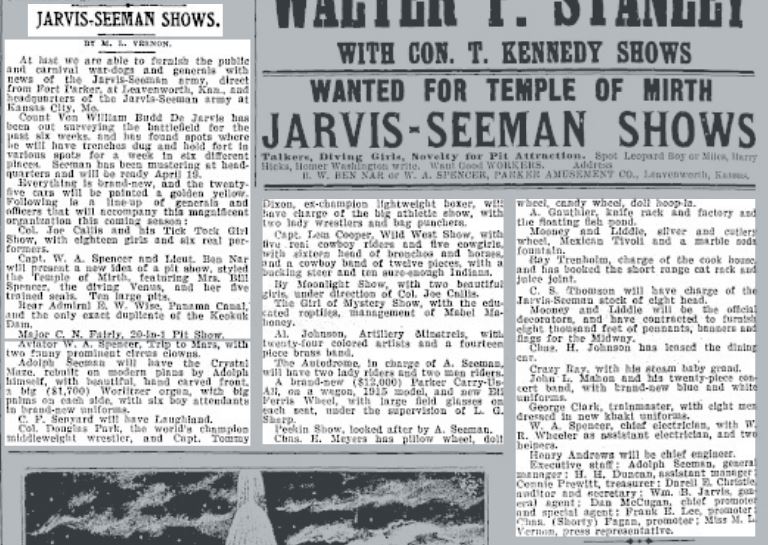
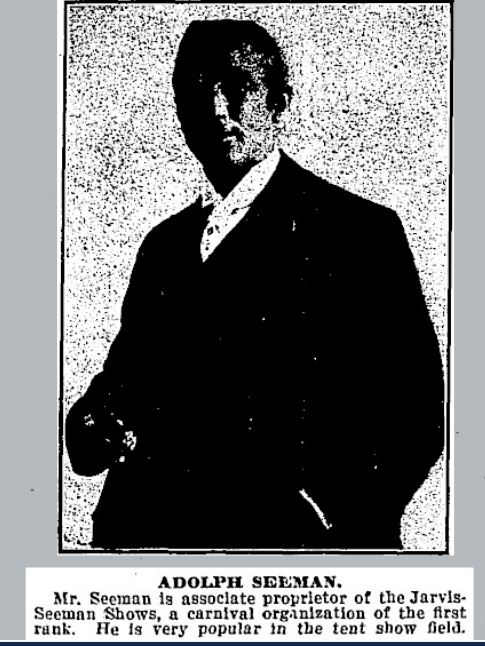
He was with the T. A. Wolfe Shows in 1923, but his recurring throat trouble took him back to Chicago for medical treatment. He died of throat cancer in Chicago’s American Hospital on August 21, 1924.
Touring With Bostock and Leavitt
Seeman toured with Frank Bostock and Frank C. Bostock’s partner, Samuel Leavitt. Their shows combined exotic animals, theatrical staging, and architectural spectacle. Seeman’s Crystal Maze became part of this touring empire, exposing thousands to the new art of immersive illusion.
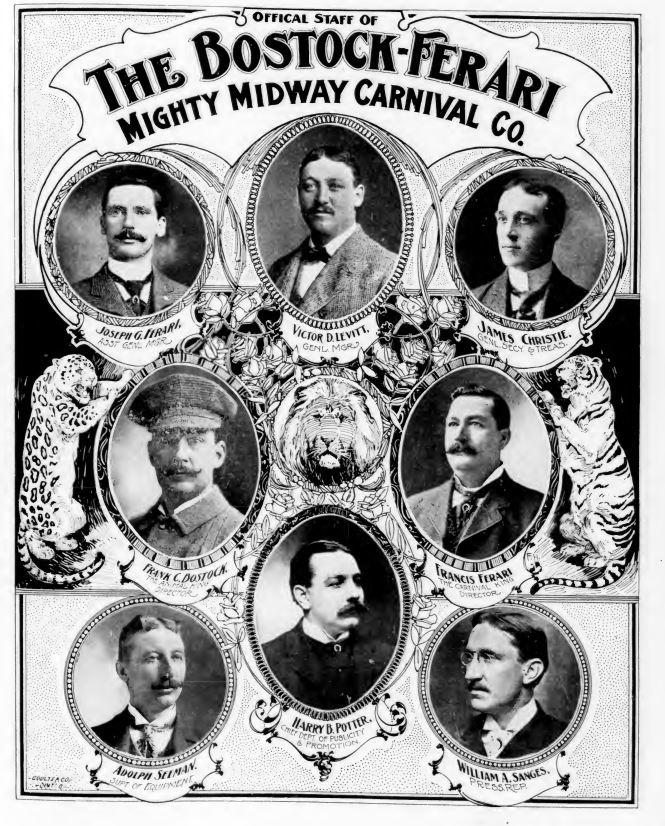
Final Years & Passing
As the industry evolved, Seeman transitioned into a respected general superintendent for major railroad carnivals. He passed away on August 21, 1924, at the age of 72 in Chicago, Illinois. Legally recognized as a bachelor, his final arrangements were handled entirely by his peers in the outdoor amusement industry.
Final Address: When he suffered his final illness and passed away on August 21, 1924, he was living in Chicago. His final services were held on Monday, August 25, 1924, at a chapel located at 226 W. Randolph Street in Chicago.
The Showmen’s League Tribute: The funeral was entirely managed and funded by the Showmen’s League of America to guarantee that the pioneering carnival operator received a proper burial in their dedicated plot.
He was interned at the Showmen’s Rest by his brother showmen, but his talent for illusion and mechanical staging brought him into the orbit of major showmen. His performances blended sleight of hand with emerging technologies, making him a pioneer of immersive entertainment.” (Sometimes his name is spelled Adolph Seaman)
Adolph Seeman is buried in Showmen’s Rest, a specialized 750-plot section located within Woodlawn Cemetery in Forest Park, Illinois (just outside Chicago).
Adolph Seeman also performed at The Salt Palace in Salt Lake City, Utah
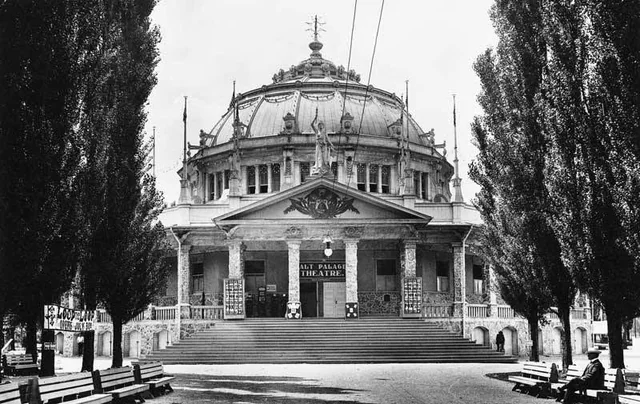
The Salt Palace in Salt Lake City (1899) carried unmistakable echoes of Seeman’s aesthetic:
- Mirrored corridors
- Moorish ornamentation
- Electric light as spectacle
- Architectural illusion as entertainment
It’s no wonder Seeman was drawn to perform at the Salt Palace as did the DeKreko Brothers and many others in the amusement business.
Adolph Seeman’s Legacy Through the DeKreko Brothers
The DeKreko Brothers — masters of mechanical funhouses and glass houses — inherited Seeman’s lineage. Their later work carried forward his principles:
- Reflection and distortion
- Mechanical surprise
- Architectural illusion
- Theatrical lighting
Seeman’s influence became part of the traveling carnival tradition.
Lineage and Connections
- Adolph Seeman → Crystal Maze
- Crystal Maze → Bostock & Leavitt Tours
- Bostock → Salt Palace
- Salt Palace → DeKreko Brothers
This lineage forms a continuous thread through the history of American amusement.
Closing Reflection
Adolph Seeman’s legacy is not just a biography — it is a design language, a way of shaping space, light, and emotion. His mirrored corridors still echo in every funhouse, every glass maze, every midway attraction that invites visitors to lose themselves in wonder.
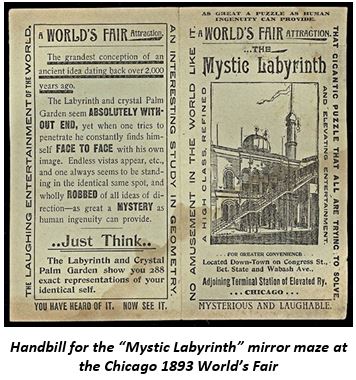
The “Mystic Labyrinth” at the 1893 Chicago World’s Fair (World’s Columbian Exposition) was a popular mirror maze attraction located in the Midway Plaisance, offering confusing pathways and illusions for visitors, a precursor to modern funhouses and glass houses, and was part of the fair’s entertainment section alongside the original Ferris Wheel and other exotic displays. Handbills advertised this “Mystic Labyrinth” mirror maze, which was later shipped out from Chicago after the fair closed, highlighting its success as an immersive, perplexing attraction.