Early Carnival Owner and Pioneer of the American Midway
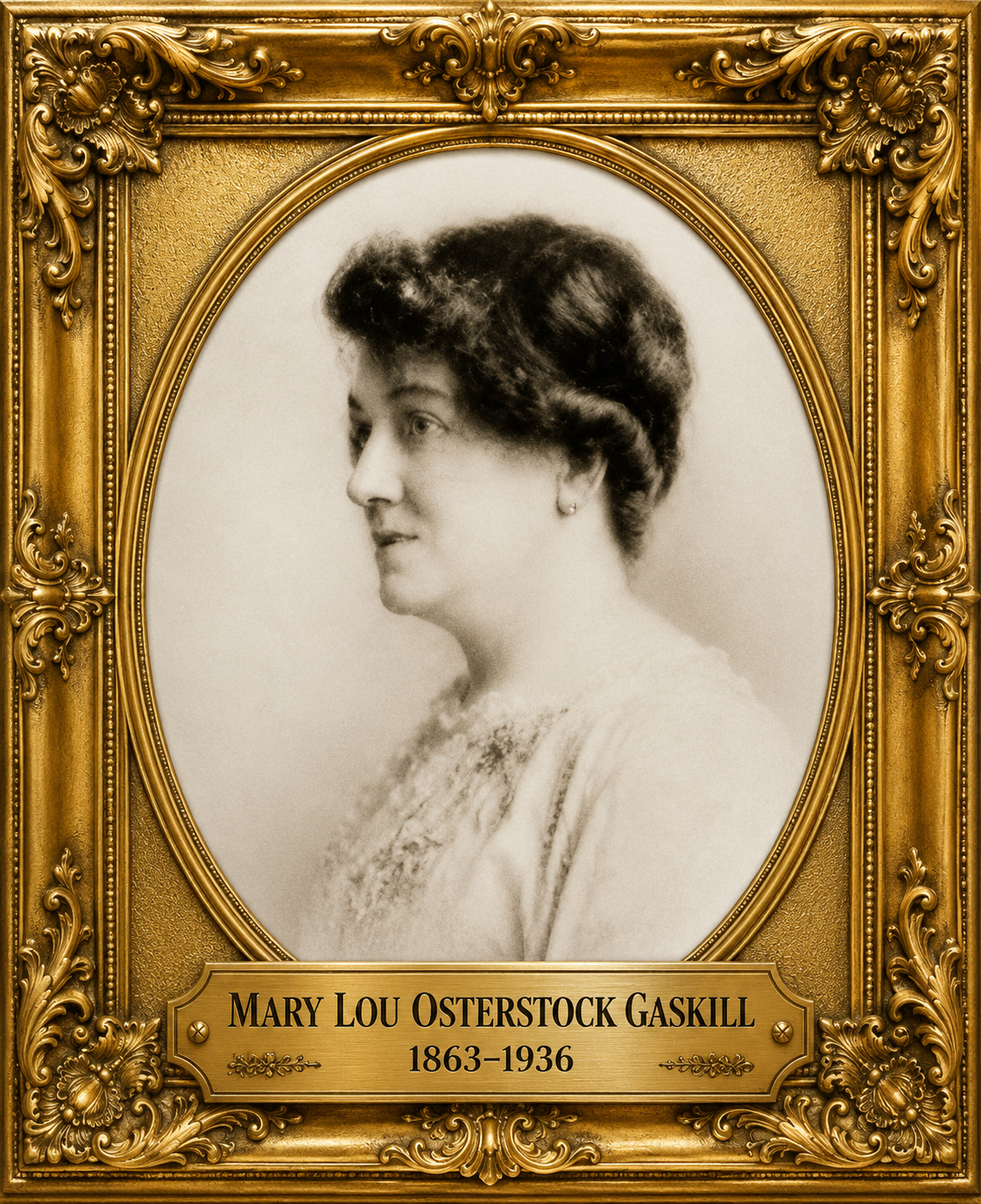
Mary Lou Osterstock Gaskill (1863–1936), early carnival owner and witness to the formative years of the American traveling midway.
Mary Lou Osterstock Gaskill has too often appeared in carnival history simply as “Mrs. Frank W. Gaskill.” Yet the surviving record reveals a woman whose place in the development of the American traveling carnival deserves recognition in her own right.
Mary was present during the formative years of the Gaskill organization. She invested money in the enterprise while the show was traveling, experienced its growth from the early street-fair years into a substantial traveling amusement organization, and after the death of her husband, Frank W. Gaskill, became the legal owner of the show.
She would also become one of the people who preserved the story of those earliest years.
A Family Built Alongside a New Industry
Mary married Frank W. Gaskill on September 1, 1881.
Their son William C. Gaskill was born October 22, 1882, in Alliance, Ohio. Another son, Frank W. Gaskill Jr., died from cholera when he was only five months old.
The death of their baby was the first of several profound losses Mary would experience during her lifetime.
As Frank’s business interests developed, Mary lived alongside a man whose ventures extended well beyond the midway. Frank’s business and amusement interests eventually led to the development of the Canton Carnival Company and the new form of organized traveling amusement that emerged at the end of the nineteenth century.
Mary was not financially detached from that enterprise. She invested money while the organization was on the road, giving her a financial connection to the business before she ever inherited it.
From Street Fairs to a Traveling Organization
George F. Dorman, who knew the organization from its beginnings, later remembered Frank’s experiments with the early Ohio street fairs and his decision to build an organized carnival that could travel under one management.
Dorman also remembered the people surrounding Gaskill in those formative years, including Harold A. Bushea, whom he identified as Gaskill’s first contracting agent.
The little organization grew.
Eventually there were attractions, concessions, animals, performers, agents and managers; winter quarters had to be maintained; routes and engagements had to be contracted; equipment had to be transported; and the show itself had to move from one community to another.
During the Gaskill-Munday period, the enterprise became large enough to operate separate units.
This was the business world in which Mary lived before she ever became its owner.
The Difficult Final Months of Frank’s Life
By 1903 the partnership between Frank Gaskill and Percy J. Munday was coming apart. Property was divided, the former partners established separate organizations, and Frank emerged with an independent Gaskill organization.
He had only a short time to enjoy it.
In the spring of 1904, Frank was again operating under the Gaskill name. After the difficult separation of the partnership and the disputes surrounding its property—including the animals—Frank was preparing for another season.
Then, on May 24, 1904, Frank W. Gaskill died of pneumonia.
Mary was a widow.
And she was now the legal owner of a traveling carnival.
Mary Gaskill — Owner of the Show
What Mary inherited was not simply the Gaskill name.
It was an operating amusement enterprise.
There were people to manage, acts under contract, routes and engagements, railroad transportation, show equipment, money, winter quarters and all of the moving parts necessary to take a large traveling organization from one stand to the next.
Importantly, many of Frank’s people stayed.
Harold Bushea was among them. His presence provided remarkable continuity because he had been associated with Frank from the formative years of the organization. Dorman remembered Bushea as Gaskill’s first contracting agent and as a man who remained connected with him for years.
The contemporary trade press demonstrates how quickly the organization continued after Frank’s death.
On June 18, 1904, The Billboard carried an advertisement for The Gaskill Carnival Company, naming Harold A. Bushea as General Director and Fred P. Shields as Treasurer. The advertisement announced forthcoming engagements in Chicago, Indianapolis and Toledo.
By July, another advertisement showed the route continuing through Toledo, Logansport and Dayton, again identifying Bushea as General Director.
These were not simply memories recorded decades later.
The show was moving. The engagements were being booked. The organization was operating.
The Minnesota State Fair
The continuing Gaskill organization subsequently reached one of the significant engagements in the history of the early American carnival: the Minnesota State Fair.
Later carnival historian Joe McKennon associated Mrs. Gaskill and Harold A. Bushea with the continuation of the organization and credited the Gaskill Carnival Company with becoming the first organized midway to play an agricultural fair in the United States.
The Minnesota State Fair’s own records document the Gaskill Carnival Co. Pike, providing independent evidence of the company’s presence at the fair.
For The American Midway Archives, McKennon’s designation of the engagement as the industry’s “first” is preserved as his historical account while the distinction continues to be researched.
But Mary’s presence in this chapter matters for another reason.
Frank was no longer there.
The Gaskill organization had survived its founder.
More Than a Final Season
The continuation after Frank’s death was not merely an effort to finish the remaining weeks of 1904.
The Gaskill name remained on the road for years.
Advertisements and trade notices document acts continuing to contract with the organization. Routes continued. Equipment continued to move. Winter quarters continued to serve the needs of the show.
The Great Gaskill Shows were still traveling by rail in November 1907. The last rail movement presently identified by The American Midway Archives occurred on November 3, 1907, when the show’s train departed for Enterprise, Alabama, for its November 4–9 engagement.
More than three years after Frank’s death, the Gaskill show was still moving.
Eventually, the show’s property was sold off in pieces, bringing this period of the Gaskill organization to a close. The Archives continues to document the disposition of those assets as individual records are located.
Mary’s Life After the Show
Mary eventually established a later life away from the traveling midway.
Census and city-directory records help us follow her after the years on the road. One particularly evocative record appears in the 1923 Minneapolis city directory.
The entry reads simply:
“Gaskill Mary L (wid Frank W)”
Nearly two decades after Frank’s death, the public record still identified Mary as Frank W. Gaskill’s widow.
Two years later, that connection with the past became historically important.
Mary Remembered
In 1925, Mary contributed her recollections of the early Gaskill years to The Billboard.
She was no longer simply living the history.
She was preserving it.
Mary remembered the early organization, its people, attractions and development. Other survivors of that pioneering Gaskill circle also left recollections, including George F. Dorman and Harold Bushea.
Together, their accounts give us something unusually valuable: perspectives from people who had actually been there while the organized traveling carnival was taking shape.
For Mary, those memories also belonged to a life she had once shared with Frank.
By the time she wrote them, he had been gone for more than twenty years.
A Life That Carried Loss
Mary’s life cannot be understood only through carnival history.
She was also a woman who experienced extraordinary loss.
She and Frank buried their infant son, Frank W. Gaskill Jr., when he was only five months old.
Then Mary lost Frank in 1904 and was left to carry forward both her own life and the business that had occupied so much of their shared one.
More than thirty years later came another loss.
Their surviving son, William C. Gaskill, died in February 1935 at the age of fifty-two.
Mary had now survived both of her sons and her husband.
She died the following year, on October 22, 1936. The Billboard recorded the death of “Mrs. Mary Ostersdock Gaskill, widow of Frank W. Gaskill, one of founders of carnival industry in America,” in Minneapolis.
Her Place in the American Midway
Mary Lou Osterstock Gaskill should not disappear into history as merely the widow of a pioneering showman.
She had lived inside the development of the Gaskill enterprise. She had money invested in it. She understood the world of routes, performers, winter quarters, transportation and a show large enough to require separate units and experienced managers.
Then Frank died.
Mary became the legal owner, and the organization continued.
Among the early showmen and women presently being reconstructed by The American Midway Archives, Mary is the earliest woman we have encountered who became owner of and participated in carrying forward an organized traveling carnival company.
More women may emerge as the Archive grows. If they do, their stories will be added.
For now, the surviving evidence gives Mary Gaskill a place of her own among the Early Pioneers of the American Midway.
She was an investor, an owner, a mother and widow, an eyewitness to the industry’s beginnings—and ultimately one of the people who made sure its story survived.
Vital Records
Mary Lou Osterstock Gaskill
Born: 1863
Died: October 22, 1936 — Hennepin County, Minnesota
Burial: Lakewood Cemetery, Minneapolis, Minnesota
Spouse: Frank W. Gaskill
Children: William C. Gaskill; Frank W. Gaskill Jr.
Find A Grave
Mary Lou Osterstock Gaskill — Find A Grave Memorial 123378728
Carnival Companies & Organizations Associated with Mary Gaskill
Canton International Exposition and Carnival Company / Canton Carnival and Exposition Company / Canton Carnival Company — 1899 onward
Gaskill-Munday Carnival Company — 1901–1903
Gaskill-Munday-Levitt/Leavitt organization — 1903
The organization operated two units in 1903—Frank’s Eastern unit and Munday’s Western unit.
Gaskill Carnival Company / Great Gaskill Shows — 1904–1907 documented continuation
Related Early Pioneers
Frank W. Gaskill
George F. Dorman
Percy J. Munday
William C. Gaskill
Victor D. Levitt
Harold A. Bushea
Sources & Resources
Primary and Contemporary Sources
The Billboard, March 21, 1925, Spring Special — Mrs. Frank W. Gaskill’s firsthand recollections of the early Gaskill organization.
The Billboard, March 21, 1925, Spring Special — Harold A. Bushea’s recollections of Frank Gaskill and the development of the early organization.
The Billboard, March 21, 1925, Spring Special — George F. Dorman’s recollections of the early carnival industry and Gaskill organization.
Contemporary Billboard advertisements, routes, personnel notices and reports for the Canton Carnival Company, Gaskill-Munday organization, Gaskill Carnival Company and Great Gaskill Shows, including post-1904 evidence documenting continuation after Frank’s death.
Minnesota State Fair historical records — documentation of the Gaskill Carnival Co. Pike as a contracted concession. Our existing research distinguishes that documented appearance from McKennon’s later claim concerning its historical “first.”
1923 Minneapolis City Directory — Mary L. Gaskill listed as “wid Frank W.”
Minnesota Death Certificate Index — Mary L. Gaskill, October 22, 1936, Hennepin County, Certificate No. 1936-MN-024054.
Genealogical and census records — used to document Mary’s family and later residences.
Find A Grave Memorial 123378728 — Mary Lou Osterstock Gaskill — burial and family-reference resource.
Secondary Historical Source
Joe McKennon, A Pictorial History of the American Carnival — Gaskill organization, growth, two-unit operation, partnership history, and post-Frank continuation under Mrs. Gaskill and Harold Bushea.