Frank W. Gaskill
The Businessman Who Helped Build the American Midway
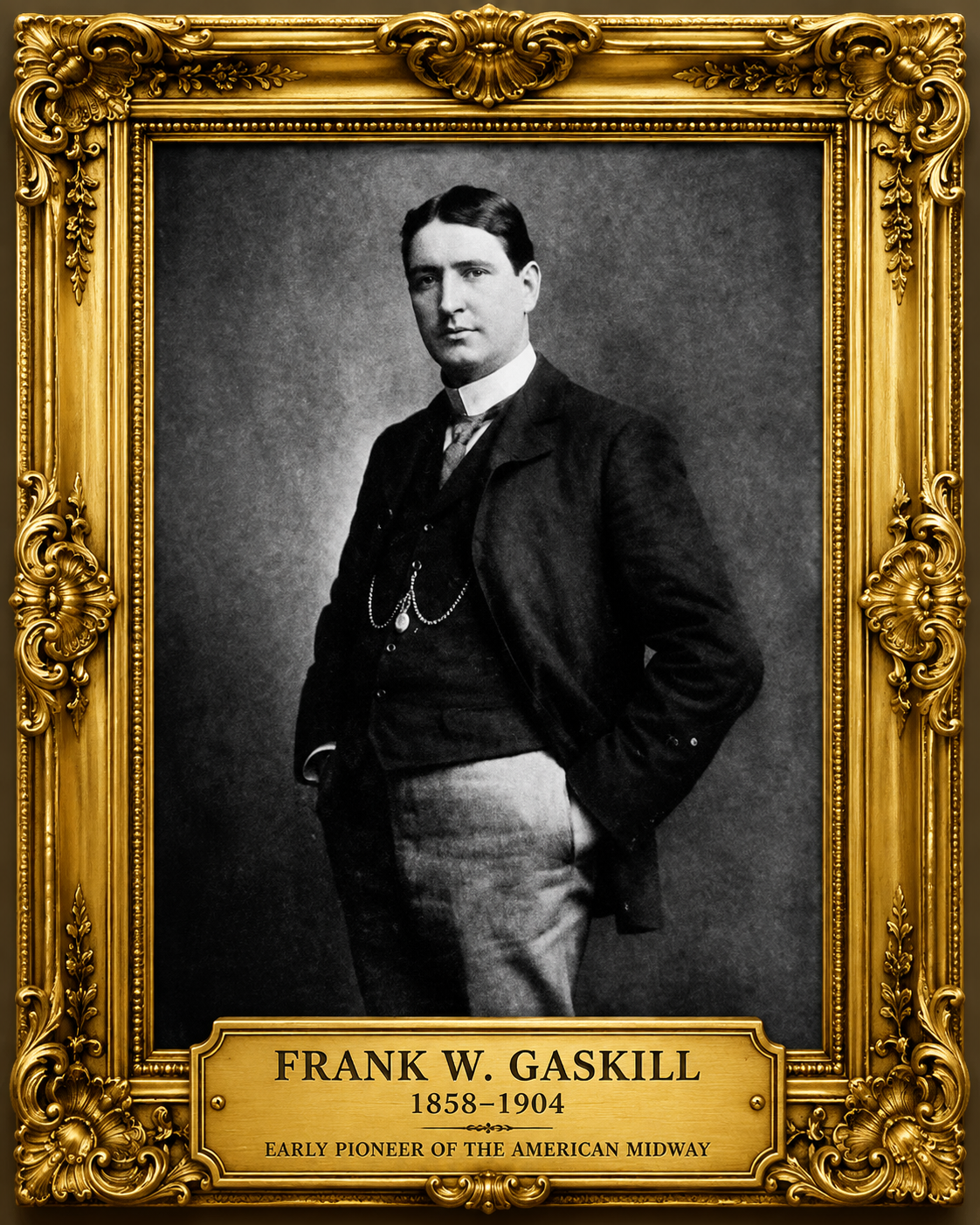
Before there was a Great Gaskill Show, before railroad cars carried his midway from city to city, and before elephants, camels, wild animals, performers, and elaborate attractions filled the streets of American towns, Frank W. Gaskill was a businessman.
That matters.
Because Frank did not simply wake up one morning and become a carnival showman. Almost everything he had done before entering the amusement business helped prepare him for what he would eventually build.
He understood merchandise and provisioning.
He understood advertising.
He understood hotels and theatrical management.
He understood businessmen, civic organizations and contracts.
And perhaps most importantly, he understood what it meant to fail—and begin again.
From Alliance, Ohio
Frank W. Gaskill was born in Alliance, Stark County, Ohio. Later carnival historian Joe McKennon gave his birth year as 1857, while other records place his birth on January 28, 1858. The discrepancy is preserved here rather than silently resolved because both dates appear in the historical record.
Frank learned responsibility early.
When his father died while engaged in railroad grading work, Frank was only about fifteen years old. According to later accounts, the teenager completed his father’s contract and helped support the family.
The railroad would return to Frank’s life years later in an entirely different way.
For now, he became a businessman.
In Alliance, Frank operated businesses that included groceries and provisions and became involved in bakery, ice, fish, and other commercial enterprises. He also entered the entertainment world through theatrical and hotel management. He managed an opera house and later had connections with the Yohe Hotel.
His business card from the period reveals an unusual combination of enterprises under one name: groceries, bakers and confectioners; camp supplies; opera-house management; and control of billboards in Alliance.
He supplied traveling organizations, including major shows, when they came through the area.
And he distributed The Billboard.
Long before Frank owned a traveling carnival, therefore, the traveling-show business was coming to him.
Performers and showmen needed food, supplies, lodging, advertising, and places to perform. Frank occupied the intersection of all of them.
Business Failure
Not everything Frank attempted succeeded.
An Alliance newspaper reported that his grocery and provisions business failed, with approximately $12,000 in assets against $15,000 in liabilities. The headline announced bluntly that Frank W. Gaskill had been “forced to the wall.”
That failure belongs in his story.
The man who would later build and rebuild traveling amusement organizations already knew what it meant to see a business collapse.
He also knew how to start again.
The Elks and an Idea
During the late 1890s, street fairs were becoming increasingly popular across the United States.
Downtown streets could be transformed for several days. Merchants decorated their storefronts. Bands played. Parades moved through town. Fraternal and civic organizations sponsored celebrations. Booths, free acts, and amusements drew enormous crowds.
Frank understood this world particularly well.
He belonged to the network of fraternal and business organizations that made such celebrations possible, including the Elks and other lodges. He knew what local businessmen cared about because he was one of them.
In 1898, the Canton Elks held a street fair and carnival.
Frank became deeply involved in its management.
Mary Gaskill later remembered the event as an important beginning in her husband’s carnival career. George F. Dorman, another early participant, also looked back on the Canton fair as part of the formative period from which Frank’s traveling organization emerged.
Frank saw something in the street fair that went beyond a single celebration.
Instead of every town independently assembling unrelated attractions, why not organize the midway itself?
Build the fronts.
Assemble the attractions.
Contract with local committees.
Move the organization from town to town.
The businessman was becoming a showman.
Decoration Day, 1899
The new organization went onto the road in 1899.
Mary Gaskill later identified its first stand as Chillicothe, Ohio, during Decoration Day week.
To understand that date, a modern reader has to imagine Decoration Day before automobiles, radio, television, airplanes, smartphones or modern mass entertainment.
Decoration Day—what became Memorial Day—could involve entire communities.
Businesses decorated.
Bands played.
Parades filled the streets.
People traveled into town.
A celebration could become one of the major public events of the year.
Into that world came Frank Gaskill’s midway.
Mary remembered elephants and camels, Oriental performers, elaborate fronts and a parade. More than forty people associated with the “Oriental” attractions traveled with the organization, according to her later account—the historical terminology being preserved here because it reflects how the attractions were described at the time.
Among the men helping Frank were people whose names would later become part of carnival history themselves.
Harold Bushea served as general agent. Joe Conley worked in advance. Albert Lansing served as treasurer before Ed Bender. Fred Staples handled a ticket box. Other young amusement men circulated through the organization.
This was not merely the story of one man.
A generation of showmen was learning the business.
And Mary remembered one particularly revealing detail.
When the organization began, its equipment could be carried in one baggage car.
By the end of that first season, she remembered it returning by special train.
The experiment had grown.
Winter Quarters — Canton, 1900
When the traveling season ended, the carnival did not cease to exist.
It went home.
The New York Clipper listed Gaskill as wintering in Canton, Ohio, and a February 1900 report gives a rare glimpse inside those quarters.
The Canton Carnival Company boasted that its winter quarters were among the finest in the business.
Show-business people visited.
Animals remained in the quarters.
One company member reportedly received a scratch while playing with one of the baby lions.
And amid preparations for another season, the trade paper caught Frank doing something wonderfully ordinary.
He was arranging a “zoological party” for his friends and joking with his chef about it.
It is a tiny detail.
But it allows us, for a moment, to see the man behind the company name.
For a few winter months, the traveling midway had a home.
Then it was time to move again.
1900 — The Road Teaches Its Lessons
Frank entered the 1900 season with enormous expectations.
Contemporary reports show a company capable of drawing remarkable crowds.
At Baltimore, the Canton Carnival Company reported playing to more than 300,000 people during a two-week engagement.
At Williamsport, Pennsylvania, the show appeared under the auspices of the I.O.O.F.
Then a storm struck.
Wind and rain tore through the midway on opening night. The enclosure surrounding the Streets of India was blown down. Tents and scenery went to the ground.
The New York Clipper placed Frank’s loss at approximately $1,500.
The show nevertheless reported attendance of about 80,000 during the week.
Then came Pottsville.
There, playing under the auspices of the Third Brigade Band, the company reported more than 100,000 visitors during seven days, with Friday night, June 22, described as the record-breaking night of the engagement.
One week could put scenery on the ground.
The next could produce record crowds.
That was the economics of the early outdoor midway.
And Frank learned another lesson: success did not protect a showman from disaster.
The 1900 season ultimately brought serious financial reverses. Later recollections describe both Gaskill and other early organizations encountering financial distress. Frank again found himself rebuilding.
Around him, some of the young men who had learned the business in this emerging carnival world were becoming ambitious themselves.
Bill Rice, George F. Dorman and Harry R. Polack would later leave their own accounts of these formative years. Their memories do not agree perfectly in every detail, and they should not be forced to.
Their accounts are preserved as the recollections of men who were there.
One particularly important caution concerns Harry Sourbeck, who remained part of later showmen’s memories of the early American Amusement Company story even though contemporary evidence establishes that he died in January 1899, before its 1900 season.
Memory had already begun turning history into legend.
The Archive preserves both.
1901 — Bigger, More Organized, More Ambitious
Frank rebuilt.
By July 1901, an advertisement for the Canton Carnival Company gives us an extraordinary measure of how far the organization had come.
The company wanted first-class performers and proclaimed:
“nothing too good.”
It sought performers ranging from musicians and sword fighters to acrobats and other specialty acts.
The advertisement claimed that the organization employed more than 150 people.
It also published the movements of the company’s representative, allowing correspondence and business to follow the advance operation from town to town.
This was no longer simply a collection of attractions.
It was becoming an organized traveling business.
The advance department worked ahead.
Privileges were sold.
Performers were recruited.
Committees were contracted.
The midway followed.
And Frank publicly warned that thieves and grafters attempting to work the streets of his fairs would be arrested.
That notice tells us something important about the business model.
The local committee was trusting the carnival with its streets, its celebration and, ultimately, its reputation.
Frank was not merely selling entertainment.
He was selling an organized midway.
Bill Rice later described the elaborate responsibilities involved in early Gaskill-style contracts: committees might provide arches, booths, bandstands, midway fencing, entrances, ticket boxes, free-act stages, electrical wiring, advertising, water, licenses, bands and other necessities.
Bushea later connected the percentage arrangement used by Gaskill to theatrical sharing agreements.
Frank’s theatrical and business background had found its new application.
The midway had a contract.
And versions of that basic relationship between show and fair or sponsoring organization would survive long after Frank was gone.
Gaskill and Mundy
As the organization grew, Percy J. Mundy became increasingly important to the next stage of Frank’s career.
Together they built something substantially larger.
Animal attractions, equipment, performers, and major dates were brought into an increasingly complex organization. By 1903 the enterprise had become large enough to operate in separate units—an Eastern unit associated with Frank and a Western unit associated with Mundy.
Rail transportation made such growth possible.
A railroad carnival was not merely a carnival that rode a train.
The train was part of the operating system.
Wagons, animals, tents, fronts, scenery, electrical equipment, concessions and personal possessions had to be loaded. Railroad connections had to be made. The organization had to reach the next town, unload, build, operate, tear down, reload and move again.
Meanwhile, the advance department was already working farther along the route.
The midway had become a moving business organization.
The growth can be measured against Mary’s memory:
1899 — one baggage car.
Only a few years later — an organization large enough to be divided into separate operating units.
But greater scale meant greater complexity.
And eventually the partnership began to break.
1903 — The Partnership Comes Apart
By 1903, the Gaskill-Mundy enterprise involved not merely two personalities but substantial property, attractions, animals, equipment, and other business interests.
Victor D. Leavitt had also become involved in the organization.
The 1903 season also brought serious legal trouble involving Gaskill’s partner Percy J. Mundy. While the Gaskill-Mundy organization was exhibiting in East St. Louis in June 1903, Mundy and an employee, Sylvester Baker, were arrested in connection with the alleged abduction of six-year-old Mike Leyden, whose father had previously been connected with the show. Contemporary newspaper accounts followed the case into court. The American Midway Archives is continuing to assemble the surviving newspaper and court record of the proceedings and their disposition.
Dorman independently places the dissolution at Austin, Texas, in fall 1903, followed by Gaskill and Mundy putting out separate shows in 1904. And our contemporary evidence shows that the property separation continued into the winter: the February 10, 1904 Waco Times-Herald reported a settlement of the jointly held carnival property after approximately two months in receivership.
When relationships deteriorated, separating the partners was not as simple as shaking hands and going different ways.
Someone had possession of the physical show.
Property had to be divided.
Equipment had to be recovered.
Ownership interests had to be settled.
The dispute ultimately entered the courts.
A receivership was established while the property of the enterprise was sorted out, and contemporary reporting documents proceedings to partition jointly held property.
For a traveling showman, that distinction mattered enormously.
The assets were not merely figures on a balance sheet.
The equipment was the show.
Without the animals, wagons, fronts, tents, attractions and transportation, there was nothing to open in the next town.
Once again, Frank had to rebuild.
San Antonio
Frank and his family established themselves in San Antonio, Texas, during this period.
Frank opened a zoo there.
And San Antonio brought him into another world he understood particularly well: businessmen, civic organizations, committees, and a major public celebration.
Frank proposed an enormous spring carnival to be held in connection with the city’s San Jacinto celebration and Battle of Flowers.
The purpose was not simply amusement.
Contemporary reporting described the proposed carnival as benefiting efforts associated with preservation of the Alamo, including fundraising connected with the Daughters of the Republic of Texas.
Frank had already presented midway attractions on San Antonio’s plazas.
Now he was proposing something considerably larger.
The negotiations were difficult.
Different organizations wanted different territory.
West Side businessmen had interests.
The women raising money for the Alamo had theirs.
City Council became involved.
Percentages were argued.
Terms changed.
And Frank negotiated.
It was precisely the sort of business environment for which his earlier life had prepared him.
Before the midway could be built, the deal had to be built.
Former Partners, Opposite Sides of the Plaza
By the spring of 1904, Gaskill and Mundy were no longer partners.
They were competitors.
And in San Antonio, their organizations appeared during the same enormous carnival celebration.
Contemporary reporting described them as “rival competitors during the carnival.”
Their operations occupied different portions of the celebration.
The men who had once built a show together were now operating on opposite sides of the city’s plazas.
And the dispute between them had moved beyond business disagreement.
Frank’s interests filed a $3,000 lawsuit alleging the willful poisoning of twelve lions and three pumas, resulting in the deaths of two lions.
The allegation must remain precisely that—an allegation made in litigation. The surviving newspaper report does not, by itself, establish who poisoned the animals or whether the allegation was proved.
Another action sought commissions the Gaskill interests claimed were due from the Loop-the-Loop attraction exhibited on Alamo Plaza.
Again, the Archive preserves the distinction between a claim and a judgment.
But the lawsuits demonstrate how far the former partnership had deteriorated.
Standing on Frank’s Midway
Fortunately, contemporary San Antonio reporting lets us do more than describe the business dispute.
It lets us see the midway.
On Military Plaza, under Frank Gaskill’s personal supervision, visitors encountered a collection of wild animals that included lions, leopards, pumas, jaguars, hyenas, panthers and polar bears.
Elephants and camels could be ridden around the esplanade.
There was a Crystal Maze.
Humpty Dumpty.
The Roberta Show.
A Haunted Castle.
An Illusion Theater.
A Ferris wheel.
Other portions of the celebration offered stadium performances, Wild West entertainment, aerialists, acrobats, strongmen, bands, balloon ascensions and parachute leaps.
Imagine the transformation.
In 1899, the equipment for Frank’s new traveling midway had fit into one baggage car.
Five years later, stand in the middle of San Antonio and look around.
This was what it had become.
The Season Frank Expected to Break Records
Later historian Joe McKennon wrote that Munday had booked the San Jacinto celebration that Gaskill had originally proposed, but that neither organization alone had sufficient equipment for the enormous date and both ultimately participated.
McKennon also remembered Frank predicting that the 1904 season would break all records.
That account is valuable, but it remains a later historical account until the contemporary source behind it is located.
What is beyond dispute is that Frank did not live to see the season through.
In May 1904, while the show was in Pittsburg, Crawford County, Kansas, Frank became ill with pneumonia.
He died there on May 24, 1904.
He was forty-six years old.
His body was returned to Ohio for burial.
After his death, a Canton Elks memorial remembered something more personal than his business accomplishments.
Frank was described as a “large whole-souled fellow”, jovial and good-natured, with a smile for everybody, someone who looked toward the bright side of things.
That remembrance feels different after following his life.
Alliance business failure.
Storms.
Financial reverses.
Rebuilding.
A partnership collapse.
Receivership.
Litigation.
And still another season being built.
We do not need to call Frank resilient.
We have watched him be resilient.
Mary Gaskill and the Show Frank Left Behind
Frank’s death did not end the Gaskill story.
And Mary Gaskill did not suddenly enter that story in May 1904.
She had been there.
She had lived through the Alliance years.
She had watched Frank become a showman.
She knew the people who helped build the organization.
She saw the little 1899 operation grow into a substantial traveling carnival.
When Frank died, Mary lost her husband.
She was also left with an amusement organization already in motion.
Performers had been contracted.
Dates were waiting.
Equipment was traveling.
Animals had to be cared for.
Employees depended upon the show.
Only eleven days after Frank’s death, the June 4, 1904 New York Clipper featured the Pacheco Family, described as Chilean acrobatic performers who were creating a sensation with the Gaskill Carnival Company and had contracted with the organization for thirty-eight weeks.
The show had a season underway.
And it continued.
Mary, together with experienced members of the organization including Harold Bushea, and with Frank and Mary’s son William Gaskill involved in the business, carried the Gaskill organization forward. The surviving record shows the company continuing into 1905 and beyond.
In July 1905, the New York Clipper reported that the Great Marinellas, ring experts, were playing a four-week engagement with the Gaskill Carnival Company, presenting their feature in the Stadium twice daily.
In September 1905, an advertisement headed GREAT GASKILL SHOWS was still recruiting performers and publishing upcoming engagements at Omaha and Wichita.
The show was still hiring.
Still contracting.
Still routing.
Still performing.
Still carrying the Gaskill name.
Harold Bushea later remembered that the organization remained on the road for almost three years after Frank’s death.
Frank died. The Gaskill show did not.
Mary Remembers
Then the story gives us one final scene.
It is 1925.
More than two decades have passed since Frank’s death.
The American carnival business has changed enormously. Railroad shows have grown. Organizations have come and gone. Men who were young around Frank’s early midway have become veteran showmen.
And Mary Gaskill looks backward.
She tells The Billboard about Canton.
The Elks fair.
The first fronts.
The elephants and camels.
The performers.
The parade.
Chillicothe.
Harold Bushea.
Joe Conley.
Albert Lansing.
Ed Bender.
Fred Staples.
And the little traveling organization whose equipment once fit into one baggage car.
Mary was not simply preserving something her husband had done.
She had lived it.
She had seen its beginning.
She had seen it grow.
She had lived through its setbacks.
And when Frank was gone, she had participated in its continuation.
Her testimony is one of the reasons we can tell his story today.
Who Was Frank W. Gaskill?
Frank Gaskill’s importance to carnival history cannot be reduced to a claim that he “invented” the carnival.
The American midway did not emerge from the imagination of one person. It developed from world’s fairs, street fairs, theatrical traditions, animal shows, concessionaires, showmen, railroads, civic celebrations and the efforts of many people whose ideas crossed and combined.
Frank’s contribution was different—and perhaps more interesting.
He understood how to organize it.
The groceryman understood supplies.
The hotel man understood traveling people.
The opera-house manager understood entertainment.
The billboard man understood advertising.
The lodge member understood committees.
The businessman understood contracts.
And the man who had experienced failure understood that when something fell apart, sometimes the only thing to do was build again.
He helped turn separate attractions into an organized traveling midway that could contract with a committee, arrive in a town, create a temporary amusement world, take it apart and move it somewhere else.
The system would grow far beyond anything Frank lived to see.
But many of its fundamentals remain recognizable in the carnival business today.
Perhaps the best way to remember him is not at the height of the San Antonio midway, surrounded by animals and attractions.
Perhaps it is back in Canton during the winter of 1900.
Baby lions are in the quarters.
Show-business people are dropping by.
Another season is being prepared.
And Frank Gaskill—the businessman who was becoming one of America’s early carnival showmen—is planning a party for his friends and making a joke to the chef.
He could not have known that more than a century later anyone would still be looking for him.
But we are.
And because Mary and the people who knew him remembered, Frank W. Gaskill’s story is still here.
Vital Records
Frank W. Gaskill
Born: January 28, 1858 — Alliance, Stark County, Ohio
Died: May 24, 1904 — Pittsburg, Crawford County, Kansas
Cause of Death: Pneumonia
Burial: Alliance City Cemetery, Alliance, Ohio
Wife: Mary Lou Osterstock Gaskill
Children: William C. Gaskill and Frank W. Gaskill Jr.
Sources & Resources
Primary and Contemporary Sources
The Billboard, March 21, 1925, Spring Special — Mrs. Frank W. Gaskill’s firsthand recollections of the early Canton midway and development of the Gaskill organization.
The Billboard, March 21, 1925, Spring Special — Harold A. Bushea’s recollections of Frank Gaskill and the early organization.
The Billboard, March 21, 1925, Spring Special — George F. Dorman’s firsthand recollections of Gaskill, the early street fairs, the Canton Carnival Company, and the development of the organized midway. Dorman specifically remembered the Munday partnership dissolving at Austin in fall 1903.
The Billboard — contemporary advertisements, routing notices, personnel reports, death coverage and later memorial references concerning Frank W. Gaskill and the Gaskill organizations.
The New York Clipper — contemporary reports and advertisements concerning the Canton Carnival Company, Gaskill organizations, routes, attractions, personnel and winter quarters.
Akron Beacon Journal, May 25, 1904 — contemporary report of Frank W. Gaskill’s death.
Waco Times-Herald, February 10, 1904 — settlement and division of Gaskill-Mundy carnival property following receivership. The contemporary evidence records the distribution of the property between the former partners.
Contemporary San Antonio newspaper coverage — Gaskill-Mundy property dispute, animal litigation, San Antonio winter quarters and Battle of Flowers/San Jacinto engagement.
Contemporary June 1903 newspaper coverage — P. J. Mundy East St. Louis arrest and court proceedings involving Mike Leyden and Sylvester Baker. We will expand the individual citations as we finish assembling that case for Munday.
Minnesota State Fair Annual Report / historical records — documentation of the Gaskill Carnival Co. Pike as a contracted concession. Our Archive draft already distinguishes that documentary evidence from McKennon’s later assertion that it represented the first organized midway at an agricultural fair.
Genealogical and vital records — used to establish Frank’s birth, marriage, family, death and burial information.
Find A Grave Memorial 5765392 — Frank W. Gaskill — burial and family-reference resource.
Secondary Historical Source
Joe McKennon, A Pictorial History of the American Carnival — Frank Gaskill, Canton Carnival Company, Gaskill-Mundy partnership, Victor Leavitt/Levitt, two-unit organization, San Antonio winter quarters, Minnesota State Fair and continuation of the organization following Frank’s death.
Related Early Pioneers
Mary Lou Osterstock Gaskill
George F. Dorman
Victor D. Levitt
Percy J. Mundy
Frank “Harry” Sourbeck
Harold A. Bushea
William C. Gaskill
W. H. “Bill” Rice
Harry Polack