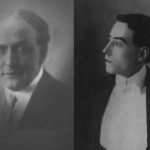
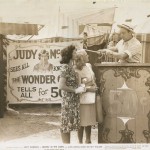
The Second Generation of the Gaskill Midway
October 22, 1882 – February 1935
William C. Gaskill was born in Alliance, Ohio, on October 22, 1882, the son of pioneering carnival showman Frank W. Gaskill and Mary Lou Osterstock Gaskill.
Unlike many children who later entered the carnival business, William did not have to discover the midway.
He grew up inside it.
As his father moved from Ohio business and theatrical management into street fairs and then the organized traveling carnival, William watched a family enterprise develop around him.
The little Canton organization grew rapidly. Mary’s recollections describe the first show leaving Canton in a baggage car and returning after the season aboard a special train. By 1903, the Gaskill-Munday-Levitt organization had become large enough to operate two traveling units.
William came of age while all of this was happening.
Working for the Family Show
The surviving record places William inside the operation rather than merely traveling as the owner’s son.
Contemporary material documents him working with the Gaskill organization, including ticket-selling and managerial responsibilities.
Then came the event that changed the Gaskill family and its business.
Frank died in May 1904.
William was only twenty-one.
His mother Mary became owner of the organization, while Harold Bushea assumed an important management role.
William stayed with the show.
W. C. Gaskill — Auditor
A remarkable Billboard advertisement from November 5, 1904 gives us direct evidence of William’s place in the post-Frank organization.
The advertisement for The Great Gaskill Shows identified:
Frank W. Gaskill — Founder
Harold A. Bushea — General Director
W. C. Gaskill — Auditor
That small line is historically important.
Frank was dead, but three parts of the Gaskill story were still visible together: Frank as founder, Mary as owner behind the continuing organization, and their son William working within its management.
William therefore represents a genuine second generation of the early organized carnival.
A Large Traveling Organization
The show William helped administer was substantial.
The November advertisement promoted hundreds of performers, animal attractions, electrical equipment, bands, and major midway attractions while routing the organization through the South.
William’s title—Auditor—also reminds us that operating a large carnival required financial administration as well as showmanship.
Money had to be accounted for as the organization traveled from town to town. Contracts, concessions, payroll, transportation, receipts, and expenses all formed part of the business behind the midway.
The Gaskill Show Continues
The organization continued beyond 1904.
The Archive holds a photograph documenting the Gaskill Carnival Company railroad wreck of June 23, 1905, evidence that the show remained a traveling railroad organization after Frank’s death.
Our continuing route research presently carries the Great Gaskill Shows through 1907.
Eventually, the show property was dispersed and William’s life moved beyond the family carnival.
Marriage and Family
William married Martha Gertrude Bell in 1923.
The family continued for another generation through William’s children and descendants, including the William and Joseph lines you have already identified in your family research.
His Final Years
William eventually lived in Minneapolis.
He died in Los Angeles in February 1935 at the age of fifty-two.
The Minneapolis newspaper obituary you located reported that his body was returned from California for burial at Crystal Lake Cemetery in Minneapolis, and identified his widow Martha and surviving family.
William’s Find A Grave record gives his birth as October 22, 1882, in Alliance, Ohio, and his burial at Crystal Lake Cemetery, Section 22, Lot 62, Space 11.
William C. Gaskill — Find A Grave Memorial 285664829
Mary survived him by only about a year after he died.
She had already buried her infant son Frank Jr. and her husband Frank. In 1935, she also buried her surviving adult son.
William’s Place in the Archive
William C. Gaskill may never have achieved the historical fame of his father.
That is precisely why his record matters.
He represents the family behind the show—the children who grew up aboard and around traveling organizations and learned the business because it was their life.
At twenty-one, after his father’s death, William did not simply disappear from the record.
He remained with the Great Gaskill Shows.
And in 1904, the trade press recorded him by name:
W. C. Gaskill — Auditor.
That earns William C. Gaskill his own place in the story of the American Midway.